
Forschung

Von der tibetischen Meditation zu den Grammatiken der KI.

Meine Forschung fragt, wie religiöse Traditionen prägen, wie Menschen Krisen begegnen, sich neue Möglichkeiten vorstellen und in der Welt handeln. Sie nahm ihren Anfang bei der tibetischen kontemplativen Praxis und der italienischen Religionsgeschichte und erstreckt sich heute auf die Geschichten, die unsere Gesellschaften über künstliche Intelligenz erzählen.

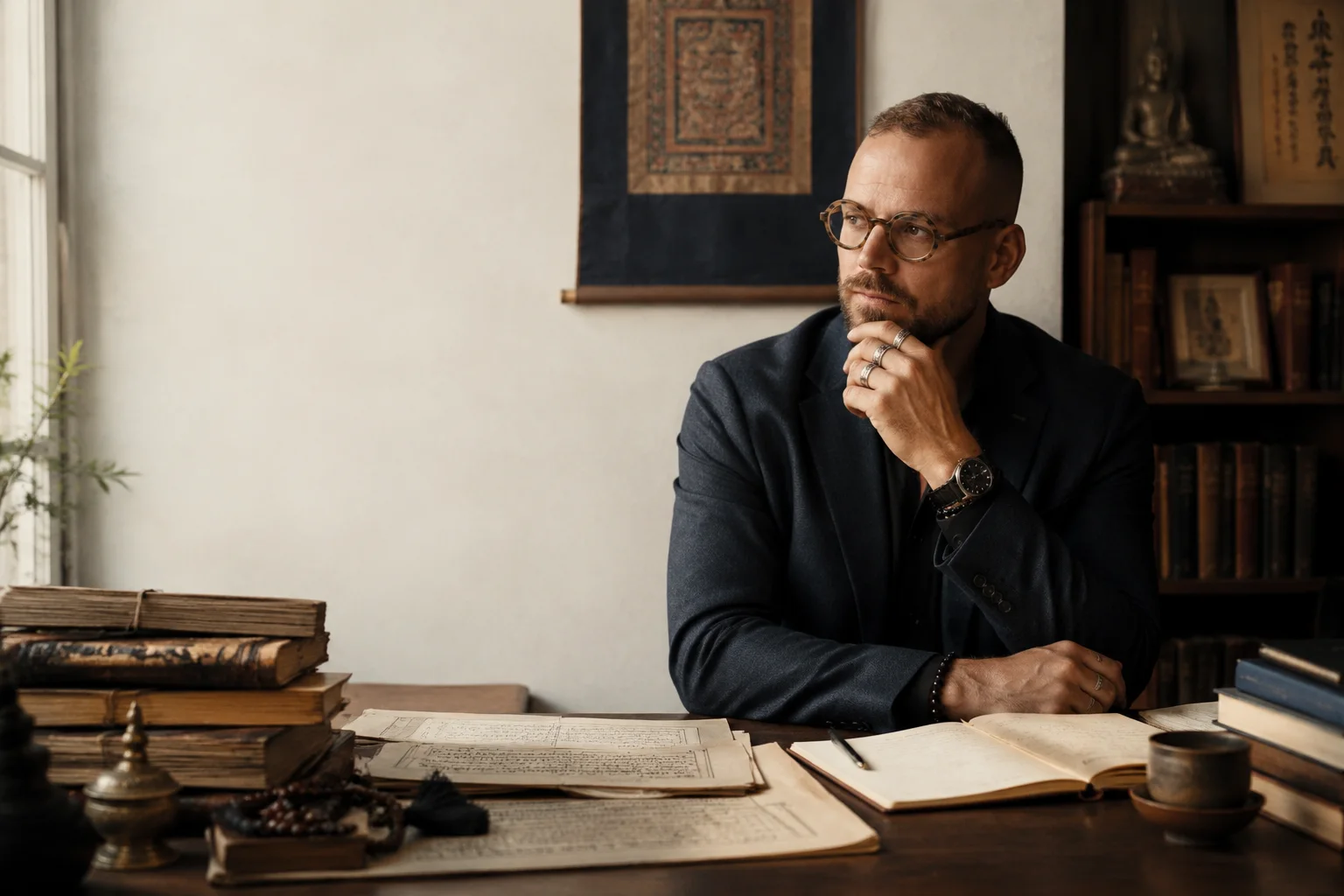
Flavio A. Geisshuesler an einem Schreibtisch mit Büchern und Manuskripten.

01In Arbeit

Aktuelle Projekte.

Monografie in Vorbereitung

Beyond Calm: Meditation as a Cultural Technology of Crisis, Vision, and Agency

Die Gegenwartskultur versteht Meditation meist als Technik der Beruhigung. Beyond Calm argumentiert, dass buddhistische Meditation etwas Grösseres ist: eine aktive, weltzugewandte Tradition, mit der Gemeinschaften Krisen begegneten, Visionen kultivierten und in der Welt handelten.

Das Buch erwächst unmittelbar aus meiner Studie zur tibetischen Himmelsschau (Bloomsbury, 2024) und weitet die Untersuchung von der Grossen Vollkommenheit auf das grössere Korpus meditativer Praktiken im indo-tibetischen Buddhismus aus.

Von dort aus gesehen erscheint die Wanderung der Meditation in säkulare und klinische Kontexte als eine Folge einer viel längeren Geschichte, in der Ruhe nur eines von mehreren Dingen war, die diese Praktiken kultivieren wollten.

Film 1:09 What people need today

Transkript lesen (Englisch)

What people need today is not calm. What they need is the capacity to act well under conditions of radical uncertainty.

I’m currently working on a book project that focuses on the activating and world-engaging dimensions of Buddhist meditation. In fact, I believe that particularly the tantric traditions have never really been about retreating from the world, but much rather about meeting it with clarity, with courage, with skill. And I think that this matters right now, probably more than ever before.

We’re living through a period of tremendous civilizational transformation. They need to be able to thrive in change. And they need to be able to take decisions in moments when it feels like the ground is moving below their feet.

And so the Buddhist traditions have been refining exactly these sorts of capacities for the last two and a half thousand years. And so part of my work here is bringing those types of resources into the present moment.

On screen: key words as captions, an animated statue of the Buddha, Earth at night, the Frontier supercomputer, a glacier (1985 → 2022), the Quadrangle of the University of Sydney, and murals of the Lukhang Temple, Lhasa. At the end: Invite Flavio to speak, flaviogeisshuesler.com/speaking, then a short outtake.

Fotografie des Supercomputers Frontier: «Frontier Supercomputer (2) (öffnet in einem neuen Tab)» von OLCF am ORNL, CC BY 2.0 (öffnet in einem neuen Tab).

Aktuelles Projekt

Religious Grammars of Artificial Intelligence: Authority, Mediation, and the Human

Die öffentliche Debatte über künstliche Intelligenz schwankt zwischen Heilsversprechen und Untergangswarnungen. Dieses Projekt liest beides als zwei Seiten einer einzigen apokalyptischen Erzählung und verfolgt die älteren religiösen Grammatiken, die in ihr wirken.

Vier davon treten hervor: Schöpfung und Schöpfer; Offenbarung, da undurchsichtige Systeme zunehmend als Wahrheitsquellen behandelt werden, die der Deutung bedürfen; Gericht; und die Frage nach nichtmenschlichen Personen, deren moralischer Status einst bei Engeln, Geistern und Ahnen zur Debatte stand.

Als Religionshistoriker beschreibe und historisiere ich diese Grammatiken, ohne Partei zu ergreifen, was das Projekt von Technikethik und Technikfolgenabschätzung unterscheidet. Es führt meine Arbeit zu Ernesto de Martino weiter, dessen Analyse kultureller Apokalypsen das Fundament meiner Monografie bei Brill bildet. Arbeiten aus dem Projekt habe ich im Mai 2026 am Minds and Intelligences Research Centre der Macquarie University vorgestellt.

Film 1:26 Can the humanities save us from AI?

Transkript lesen (Englisch)

So you can say, “Hey, this is horrible. We need to stop this. I will never, ever use AI. I’m throwing away my phone.” As soon as you turn on your phone, you’re using AI, right? People underestimate the pervasiveness of this technology.

But the point is, you have people who say, “Let’s return to the human”: restore presence, authorship, embodiment, slow reading, ethical judgment. I mean, this is my world, right? I am the humanities guy. I have two PhDs in the humanities. If you go on LinkedIn today, you have a lot of people that say, “Ah, the humanities, they will save us,” right?

But the secret is, and nobody talks about this, and nobody wants to talk about this, because the only thing that they’re not critical of is, in a way, their own thinking: the humanities, with the anti-foundationalist turn since the ’50s, ’60s, what is the French theory in France, has destroyed any sort of clear human value. Any sort of humanistic anchor that might have been there has been destroyed. And in many ways, if you read Barthes or Foucault, or you read Derrida, and it starts with Saussure, if you read these people, you can see how AI is having a field day with it. It is a dream.

If reality is completely detached from the text, and the text is just floating on top, and it’s authorless in a way, what is AI doing? It’s like, “Oh yeah, this is my world. Let’s go.” Right? This is a collaboration. Nobody’s talking about it, but the humanities are very much involved in this process, and they are not the solution to this problem. Believe me.

On screen, the film names the steps of the argument: the limits of refusal; the promise of a “return to the human”; a critique from within; the humanistic anchor; the intellectual lineage of Roland Barthes, Michel Foucault, Jacques Derrida and Ferdinand de Saussure; text without an author; and the consequence: the humanities are involved in the process they seek to resist.

Minds and Intelligences Research Centre, Macquarie University, Mai 2026 1 Min. 26 s

Öffentliche Diskussion: God Forbid · ABC Radio National · . Flavio sprach mit James Carleton und Michael Muthukrishna in God Forbid über KI und religiöse Vorstellungswelten: die Überzeugungen, Versprechen und Ängste, die unsere technologische Zukunft prägen.

02Frühere Arbeiten

Grundlagen

Drei frühere Arbeitsstränge fliessen in beide Projekte ein.

Tibetische Himmelsschau und die Grosse Vollkommenheit

Mein erstes grosses Projekt rekonstruierte den Skullward Leap, eine Technik der Himmelsschau im Buddhismus der Grossen Vollkommenheit (Dzogchen), sowie die Frühgeschichte dieser Tradition. Gestützt auf tibetische Quellen und auf Feldforschung für meine Dissertation in Nepal, liest es die Praxis vor dem Hintergrund einer älteren tibetischen Welt von Himmel, Lebenskraft und schamanischem Ritual und zeichnet nach, wie ein langer Prozess der Buddhisierung dieses Material innerhalb der Grossen Vollkommenheit umgeformt hat.

Zentrale Arbeiten Tibetan Sky-Gazing Meditation and the Pre-History of Great Perfection Buddhism (Bloomsbury Academic, 2024) «Meditation Between Open Skies and Deep Ravines» (Journal of the International Association of Buddhist Studies, 2022) «Framing the Sky of Skullward Leap» (ISMEO, 2024)

Ernesto de Martino und die italienische Religionsgeschichte

Meine Dissertation in Bern galt Ernesto de Martino (1908–1965), dem italienischen Religionshistoriker, der untersuchte, wie Kulturen auf die Bedrohung reagieren, ihre Welt zu verlieren. Sie führte zu einer Open-Access-Monografie bei Brill und setzt sich fort in Arbeiten zu de Martinos Philosophie und zur Fachgeschichte der Religionswissenschaft.

Zentrale Arbeiten The Life and Work of Ernesto de Martino (Brill, 2021) «Crisis, Culture, and Creation» (CoSMo, 2025) «A Parapsychologist, an Anthropologist, and a Vitalist Walk into a Laboratory» (Religions, 2019)

Meditation, Geist und kognitive Religionswissenschaft

Ein dritter Strang bringt kontemplative Traditionen mit der Psychologie und den Kognitionswissenschaften ins Gespräch: von einem Modell des plastischen Selbst für die kognitive Religionswissenschaft über psychologische Lesarten der frühen Literatur der Grossen Vollkommenheit bis zur Begegnung zwischen tibetischer Kontemplation und Predictive Processing.

Zentrale Arbeiten «The 7E Model of the Human Mind» (Journal of Cognition and Culture, 2019) «When Buddhas Dissociate» (Cogent Psychology, 2019) «Direct Transcendence» (De Gruyter, 2024) «From Bardo to Brain» (Brill, im Druck)

Alle Publikationen

03Förderung

Stipendien und Förderbeiträge.

Meine Forschung wurde durch die folgenden kompetitiv vergebenen Stipendien und Förderbeiträge unterstützt.

  • Azrieli International Postdoctoral Fellowship, Azrieli Foundation, Hebräische Universität Jerusalem (2021, drei Jahre)
  • Postdoc-Stipendium, Mandel Scholion Interdisciplinary Research Center, Hebräische Universität Jerusalem (2021, drei Jahre)
  • Postdoc-Stipendium, Lady Davis Fellowship Trust, Hebräische Universität Jerusalem (2020, zwei Jahre)
  • Postdoc-Stipendium, Khyentse Foundation, Hebräische Universität Jerusalem (2019, zwei Jahre)
  • Open-Access-Publikationsbeiträge, Schweizerischer Nationalfonds (2021, 2024)
  • Abschlussstipendium für die Dissertation, Dr. Josephine de Karman Trust, Universität Bern (2017)
  • Fulbright–Hays Doctoral Dissertation Research Abroad Fellowship, U.S. Department of Education, Nepal (2016, zwölf Monate)
  • Doc.Mobility-Stipendium, Schweizerischer Nationalfonds, Sapienza Università di Roma (2014, achtzehn Monate)
  • FLAS-Stipendium für Tibetisch, U.S. Department of Education, University of Virginia (2013)