
Research

From Tibetan meditation to the grammars of AI.

My research asks how religious traditions shape the way people meet crisis, imagine new possibilities, and act in the world. It began with Tibetan contemplative practice and the Italian history of religions, and it now extends to the stories our societies tell about artificial intelligence.

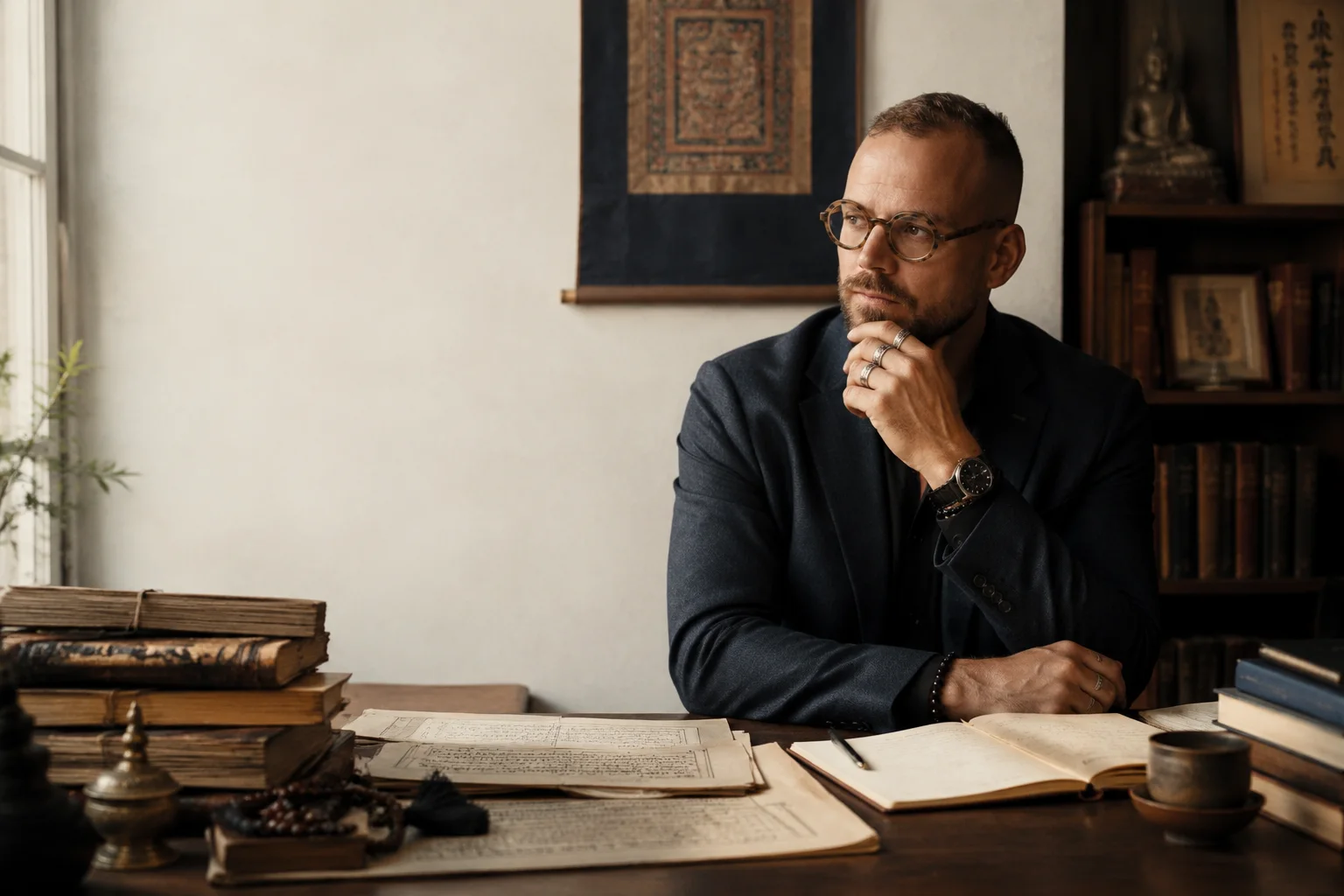
Flavio A. Geisshuesler at a desk with books and manuscripts.

01In progress

Current projects.

Monograph in preparation

Beyond Calm: Meditation as a Cultural Technology of Crisis, Vision, and Agency

Contemporary culture mostly treats meditation as a technique for calm. Beyond Calm argues that Buddhist meditation is something larger: an active, world-engaging tradition through which communities have met crisis, cultivated vision, and acted in the world.

The book grows directly out of my study of Tibetan sky-gazing meditation (Bloomsbury, 2024) and widens the inquiry from the Great Perfection to the larger corpus of meditation practices in Indo-Tibetan Buddhism.

Seen from there, meditation’s migration into secular and clinical settings becomes one consequence of a much longer history, in which calm was only one of the things these practices set out to cultivate.

Film 1:09 What people need today

Read the transcript

What people need today is not calm. What they need is the capacity to act well under conditions of radical uncertainty.

I’m currently working on a book project that focuses on the activating and world-engaging dimensions of Buddhist meditation. In fact, I believe that particularly the tantric traditions have never really been about retreating from the world, but much rather about meeting it with clarity, with courage, with skill. And I think that this matters right now, probably more than ever before.

We’re living through a period of tremendous civilizational transformation. They need to be able to thrive in change. And they need to be able to take decisions in moments when it feels like the ground is moving below their feet.

And so the Buddhist traditions have been refining exactly these sorts of capacities for the last two and a half thousand years. And so part of my work here is bringing those types of resources into the present moment.

On screen: key words as captions, an animated statue of the Buddha, Earth at night, the Frontier supercomputer, a glacier (1985 → 2022), the Quadrangle of the University of Sydney, and murals of the Lukhang Temple, Lhasa. At the end: Invite Flavio to speak, flaviogeisshuesler.com/speaking, then a short outtake.

Photograph of the Frontier supercomputer: “Frontier Supercomputer (2) (opens in a new tab)” by OLCF at ORNL, CC BY 2.0 (opens in a new tab).

Current project

Religious Grammars of Artificial Intelligence: Authority, Mediation, and the Human

Public debate about artificial intelligence swings between promises of salvation and warnings of doom. This project reads the two as sides of one apocalyptic narrative and traces the older religious grammars at work inside it.

Four of them stand out: creation and the creator; revelation, as opaque systems come to be treated as sources of truth that require interpretation; judgment; and the question of non-human persons, whose moral status was once debated for angels, spirits, and ancestors.

As a historian of religions, I describe and historicize these grammars without taking sides, which sets the project apart from technology ethics and technology assessment. It continues my work on Ernesto de Martino, whose analysis of cultural apocalypses anchors my Brill monograph. I presented work from the project at Macquarie University’s Minds and Intelligences Research Centre in May 2026.

Film 1:26 Can the humanities save us from AI?

Read the transcript

So you can say, “Hey, this is horrible. We need to stop this. I will never, ever use AI. I’m throwing away my phone.” As soon as you turn on your phone, you’re using AI, right? People underestimate the pervasiveness of this technology.

But the point is, you have people who say, “Let’s return to the human”: restore presence, authorship, embodiment, slow reading, ethical judgment. I mean, this is my world, right? I am the humanities guy. I have two PhDs in the humanities. If you go on LinkedIn today, you have a lot of people that say, “Ah, the humanities, they will save us,” right?

But the secret is, and nobody talks about this, and nobody wants to talk about this, because the only thing that they’re not critical of is, in a way, their own thinking: the humanities, with the anti-foundationalist turn since the ’50s, ’60s, what is the French theory in France, has destroyed any sort of clear human value. Any sort of humanistic anchor that might have been there has been destroyed. And in many ways, if you read Barthes or Foucault, or you read Derrida, and it starts with Saussure, if you read these people, you can see how AI is having a field day with it. It is a dream.

If reality is completely detached from the text, and the text is just floating on top, and it’s authorless in a way, what is AI doing? It’s like, “Oh yeah, this is my world. Let’s go.” Right? This is a collaboration. Nobody’s talking about it, but the humanities are very much involved in this process, and they are not the solution to this problem. Believe me.

On screen, the film names the steps of the argument: the limits of refusal; the promise of a “return to the human”; a critique from within; the humanistic anchor; the intellectual lineage of Roland Barthes, Michel Foucault, Jacques Derrida and Ferdinand de Saussure; text without an author; and the consequence: the humanities are involved in the process they seek to resist.

Minds and Intelligences Research Centre, Macquarie University, May 2026 1 min 26 s

Public discussion: God Forbid · ABC Radio National · . Flavio joined James Carleton and Michael Muthukrishna on God Forbid to discuss AI and religious imagination: the beliefs, promises and fears shaping our technological future.

02Earlier work

Foundations

Three earlier lines of work carry into both projects.

Tibetan sky-gazing and the Great Perfection

My first major project reconstructed the Skullward Leap, a sky-gazing technique of Great Perfection (Dzogchen) Buddhism, and the tradition’s early history. Drawing on Tibetan sources and doctoral fieldwork in Nepal, it reads the practice against an older Tibetan world of sky, vitality, and shamanic ritual, and traces how a long process of buddhicization reworked that material inside the Great Perfection.

Key works Tibetan Sky-Gazing Meditation and the Pre-History of Great Perfection Buddhism (Bloomsbury Academic, 2024) “Meditation Between Open Skies and Deep Ravines” (Journal of the International Association of Buddhist Studies, 2022) “Framing the Sky of Skullward Leap” (ISMEO, 2024)

Ernesto de Martino and the Italian history of religions

My doctoral research at Bern focused on Ernesto de Martino (1908–1965), the Italian historian of religions who studied how cultures respond to the threat of losing their world. It led to an open-access monograph with Brill and continues in work on de Martino’s philosophy and on the disciplinary history of religious studies.

Key works The Life and Work of Ernesto de Martino (Brill, 2021) “Crisis, Culture, and Creation” (CoSMo, 2025) “A Parapsychologist, an Anthropologist, and a Vitalist Walk into a Laboratory” (Religions, 2019)

Meditation, mind, and the cognitive science of religion

A third line brings contemplative traditions into conversation with psychology and the cognitive sciences, from a model of the plastic self for the cognitive science of religion to psychological readings of early Great Perfection literature and the encounter between Tibetan contemplation and predictive processing.

Key works “The 7E Model of the Human Mind” (Journal of Cognition and Culture, 2019) “When Buddhas Dissociate” (Cogent Psychology, 2019) “Direct Transcendence” (De Gruyter, 2024) “From Bardo to Brain” (Brill, in press)

All publications

03Support

Fellowships and grants.

My research has been supported by these competitive fellowships and grants.

  • Azrieli International Postdoctoral Fellowship, Azrieli Foundation, Hebrew University of Jerusalem (2021, three years)
  • Postdoctoral Fellowship, Mandel Scholion Interdisciplinary Research Center, Hebrew University of Jerusalem (2021, three years)
  • Postdoctoral Fellowship, Lady Davis Fellowship Trust, Hebrew University of Jerusalem (2020, two years)
  • Postdoctoral Fellowship, Khyentse Foundation, Hebrew University of Jerusalem (2019, two years)
  • Open Access Publication Grants, Swiss National Science Foundation (2021, 2024)
  • Dissertation Completion Fellowship, Dr. Josephine de Karman Trust, University of Bern (2017)
  • Fulbright–Hays Doctoral Dissertation Research Abroad Fellowship, U.S. Department of Education, Nepal (2016, twelve months)
  • Doc.Mobility Fellowship, Swiss National Science Foundation, Sapienza Università di Roma (2014, eighteen months)
  • FLAS Fellowship in Tibetan, U.S. Department of Education, University of Virginia (2013)