
Recherche

De la méditation tibétaine aux grammaires de l’IA.

Mes recherches examinent comment les traditions religieuses façonnent la manière dont les êtres humains affrontent la crise, imaginent de nouveaux possibles et agissent dans le monde. Elles ont commencé par la pratique contemplative tibétaine et la tradition italienne de l’histoire des religions, et s’étendent aujourd’hui aux récits que nos sociétés construisent autour de l’intelligence artificielle.

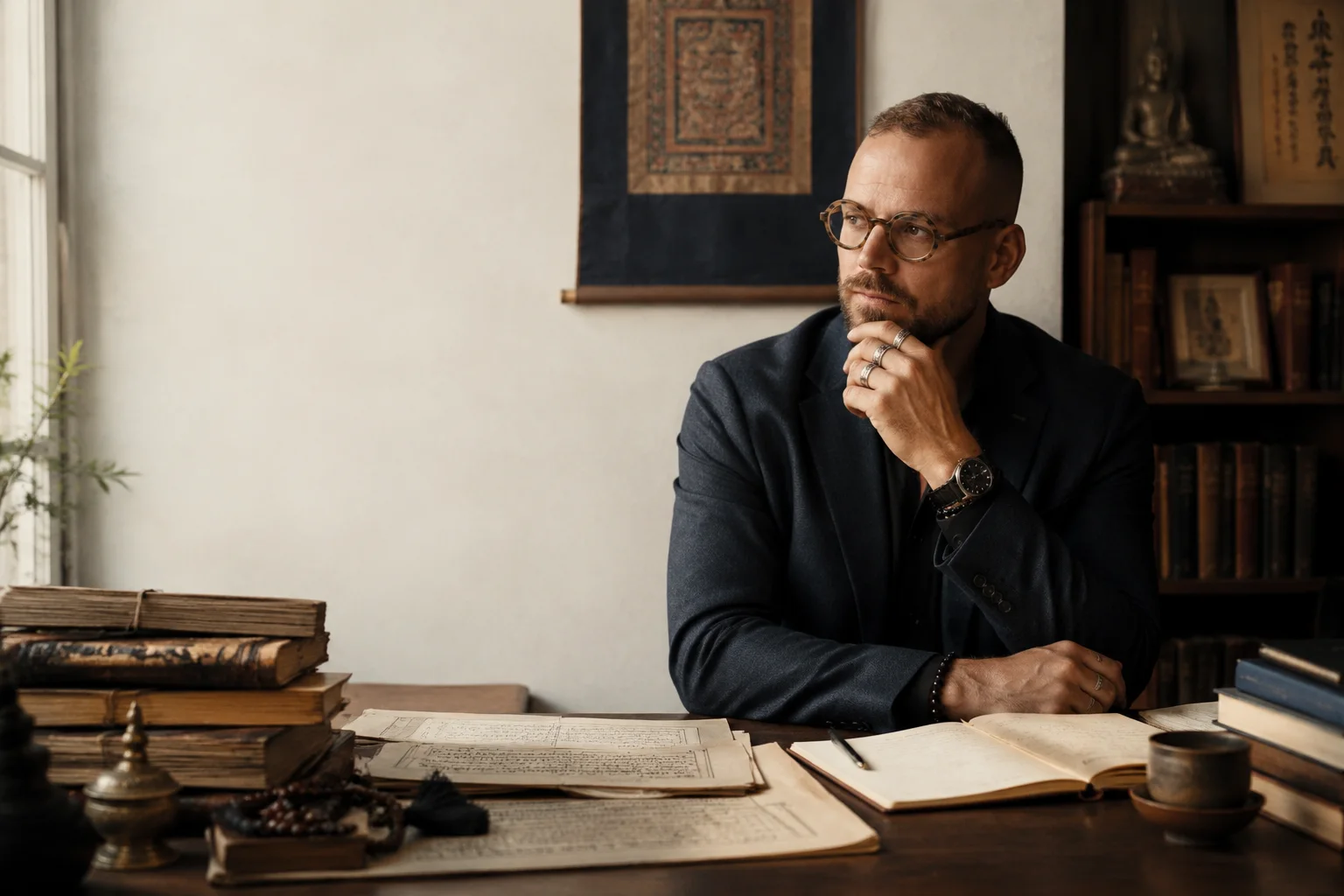
Flavio A. Geisshuesler à son bureau, parmi des livres et des manuscrits.

01En cours

Projets actuels.

Monographie en préparation

Beyond Calm: Meditation as a Cultural Technology of Crisis, Vision, and Agency

La culture contemporaine traite surtout la méditation comme une technique pour trouver le calme. Beyond Calm soutient que la méditation bouddhique est bien davantage : une tradition active, engagée dans le monde, à travers laquelle des communautés ont affronté la crise, cultivé une vision et agi dans le monde.

Le livre découle directement de mon étude de la méditation tibétaine de contemplation du ciel (Bloomsbury, 2024) et élargit l’enquête, de la Grande Perfection à l’ensemble plus vaste des pratiques méditatives du bouddhisme indo-tibétain.

Vue sous cet angle, la migration de la méditation vers des contextes séculiers et cliniques devient l’une des conséquences d’une histoire bien plus longue, dans laquelle le calme n’était que l’une des choses que ces pratiques s’attachaient à cultiver.

Film 1:09 What people need today

Lire la transcription (en anglais)

What people need today is not calm. What they need is the capacity to act well under conditions of radical uncertainty.

I’m currently working on a book project that focuses on the activating and world-engaging dimensions of Buddhist meditation. In fact, I believe that particularly the tantric traditions have never really been about retreating from the world, but much rather about meeting it with clarity, with courage, with skill. And I think that this matters right now, probably more than ever before.

We’re living through a period of tremendous civilizational transformation. They need to be able to thrive in change. And they need to be able to take decisions in moments when it feels like the ground is moving below their feet.

And so the Buddhist traditions have been refining exactly these sorts of capacities for the last two and a half thousand years. And so part of my work here is bringing those types of resources into the present moment.

On screen: key words as captions, an animated statue of the Buddha, Earth at night, the Frontier supercomputer, a glacier (1985 → 2022), the Quadrangle of the University of Sydney, and murals of the Lukhang Temple, Lhasa. At the end: Invite Flavio to speak, flaviogeisshuesler.com/speaking, then a short outtake.

Photographie du supercalculateur Frontier : « Frontier Supercomputer (2) (s’ouvre dans un nouvel onglet) » par l’OLCF à l’ORNL, CC BY 2.0 (s’ouvre dans un nouvel onglet).

Projet en cours

Religious Grammars of Artificial Intelligence: Authority, Mediation, and the Human

Le débat public sur l’intelligence artificielle oscille entre promesses de salut et annonces de catastrophe. Ce projet lit ces deux discours comme les deux faces d’un même récit apocalyptique et retrace les grammaires religieuses plus anciennes qui y sont à l’œuvre.

Quatre d’entre elles se détachent : la création et le créateur ; la révélation, à mesure que des systèmes opaques en viennent à être traités comme des sources de vérité qui demandent à être interprétées ; le jugement ; et la question des personnes non humaines, dont le statut moral fut jadis débattu à propos des anges, des esprits et des ancêtres.

En historien des religions, je décris et historicise ces grammaires sans prendre parti, ce qui distingue ce projet de l’éthique de la technologie comme de l’évaluation des choix technologiques. Il prolonge mon travail sur Ernesto de Martino, dont l’analyse des apocalypses culturelles est au fondement de ma monographie parue chez Brill. J’ai présenté des travaux issus de ce projet au Minds and Intelligences Research Centre de l’Université Macquarie en mai 2026.

Film 1:26 Can the humanities save us from AI?

Lire la transcription (en anglais)

So you can say, “Hey, this is horrible. We need to stop this. I will never, ever use AI. I’m throwing away my phone.” As soon as you turn on your phone, you’re using AI, right? People underestimate the pervasiveness of this technology.

But the point is, you have people who say, “Let’s return to the human”: restore presence, authorship, embodiment, slow reading, ethical judgment. I mean, this is my world, right? I am the humanities guy. I have two PhDs in the humanities. If you go on LinkedIn today, you have a lot of people that say, “Ah, the humanities, they will save us,” right?

But the secret is, and nobody talks about this, and nobody wants to talk about this, because the only thing that they’re not critical of is, in a way, their own thinking: the humanities, with the anti-foundationalist turn since the ’50s, ’60s, what is the French theory in France, has destroyed any sort of clear human value. Any sort of humanistic anchor that might have been there has been destroyed. And in many ways, if you read Barthes or Foucault, or you read Derrida, and it starts with Saussure, if you read these people, you can see how AI is having a field day with it. It is a dream.

If reality is completely detached from the text, and the text is just floating on top, and it’s authorless in a way, what is AI doing? It’s like, “Oh yeah, this is my world. Let’s go.” Right? This is a collaboration. Nobody’s talking about it, but the humanities are very much involved in this process, and they are not the solution to this problem. Believe me.

On screen, the film names the steps of the argument: the limits of refusal; the promise of a “return to the human”; a critique from within; the humanistic anchor; the intellectual lineage of Roland Barthes, Michel Foucault, Jacques Derrida and Ferdinand de Saussure; text without an author; and the consequence: the humanities are involved in the process they seek to resist.

Minds and Intelligences Research Centre, Université Macquarie, mai 2026 1 min 26 s

Discussion publique: God Forbid · ABC Radio National · . Flavio a rejoint James Carleton et Michael Muthukrishna dans God Forbid pour parler de l’IA et de l’imaginaire religieux : les croyances, promesses et peurs qui façonnent notre avenir technologique.

02Travaux antérieurs

Fondements

Trois axes de travail antérieurs se prolongent dans les deux projets.

La contemplation tibétaine du ciel et la Grande Perfection

Mon premier grand projet a reconstitué le Skullward Leap, une technique de contemplation du ciel propre au bouddhisme de la Grande Perfection (Dzogchen), ainsi que l’histoire ancienne de cette tradition. S’appuyant sur des sources tibétaines et sur un travail de terrain doctoral au Népal, il lit cette pratique sur l’arrière-plan d’un monde tibétain plus ancien, fait de ciel, de vitalité et de rituels chamaniques, et retrace comment un long processus de bouddhicisation a remanié ce matériau au sein de la Grande Perfection.

Travaux clés Tibetan Sky-Gazing Meditation and the Pre-History of Great Perfection Buddhism (Bloomsbury Academic, 2024) « Meditation Between Open Skies and Deep Ravines » (Journal of the International Association of Buddhist Studies, 2022) « Framing the Sky of Skullward Leap » (ISMEO, 2024)

Ernesto de Martino et l’histoire des religions en Italie

Ma recherche doctorale à Berne portait sur Ernesto de Martino (1908–1965), l’historien italien des religions qui a étudié la manière dont les cultures réagissent à la menace de perdre leur monde. Elle a abouti à une monographie en libre accès chez Brill et se prolonge dans des travaux sur la philosophie d’Ernesto de Martino et sur l’histoire disciplinaire des sciences des religions.

Travaux clés The Life and Work of Ernesto de Martino (Brill, 2021) « Crisis, Culture, and Creation » (CoSMo, 2025) « A Parapsychologist, an Anthropologist, and a Vitalist Walk into a Laboratory » (Religions, 2019)

Méditation, esprit et sciences cognitives de la religion

Un troisième axe fait dialoguer les traditions contemplatives avec la psychologie et les sciences cognitives, d’un modèle du soi plastique pour les sciences cognitives de la religion jusqu’aux lectures psychologiques de la littérature ancienne de la Grande Perfection et à la rencontre entre contemplation tibétaine et traitement prédictif.

Travaux clés « The 7E Model of the Human Mind » (Journal of Cognition and Culture, 2019) « When Buddhas Dissociate » (Cogent Psychology, 2019) « Direct Transcendence » (De Gruyter, 2024) « From Bardo to Brain » (Brill, sous presse)

Toutes les publications

03Soutien

Bourses et financements.

Mes recherches ont bénéficié du soutien des bourses et financements suivants, tous obtenus sur concours.

  • Bourse postdoctorale internationale Azrieli, Fondation Azrieli, Université hébraïque de Jérusalem (2021, trois ans)
  • Bourse postdoctorale, Mandel Scholion Interdisciplinary Research Center, Université hébraïque de Jérusalem (2021, trois ans)
  • Bourse postdoctorale, Lady Davis Fellowship Trust, Université hébraïque de Jérusalem (2020, deux ans)
  • Bourse postdoctorale, Khyentse Foundation, Université hébraïque de Jérusalem (2019, deux ans)
  • Subsides de publication en libre accès, Fonds national suisse (2021, 2024)
  • Bourse de fin de thèse, Dr. Josephine de Karman Trust, Université de Berne (2017)
  • Fulbright–Hays Doctoral Dissertation Research Abroad Fellowship, Département de l’Éducation des États-Unis, Népal (2016, douze mois)
  • Bourse Doc.Mobility, Fonds national suisse, Sapienza Università di Roma (2014, dix-huit mois)
  • Bourse FLAS pour le tibétain, Département de l’Éducation des États-Unis, Université de Virginie (2013)