Speaking

Put the room’s assumptions to the test.

Leadership. AI. And what the history of religions knows about both.

I speak at universities, conferences, and leadership meetings, and every talk grows out of my research: how people meet crisis, whom they trust as an authority, and which stories they tell when the future turns uncertain. I speak in English, German, French, and Italian.

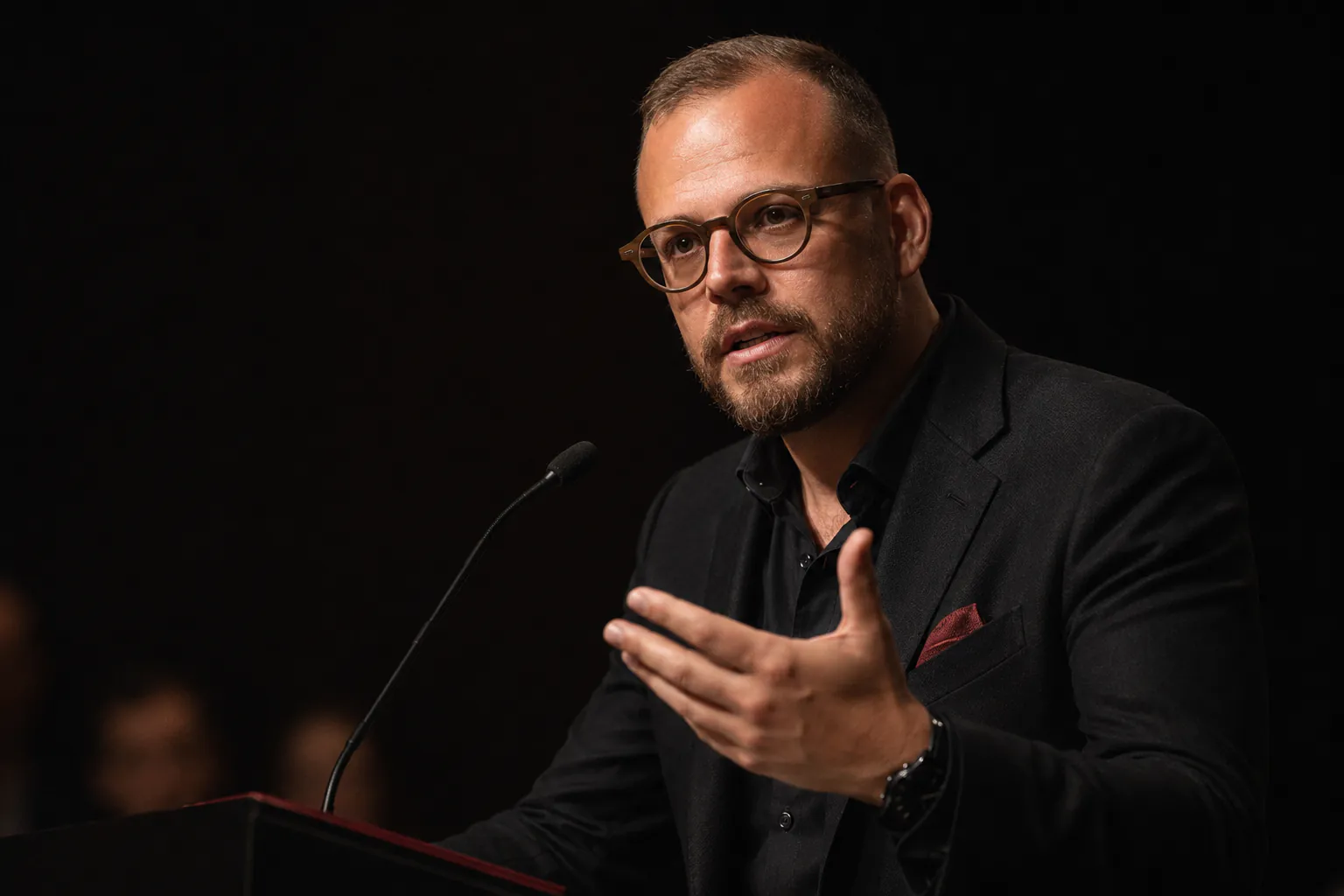
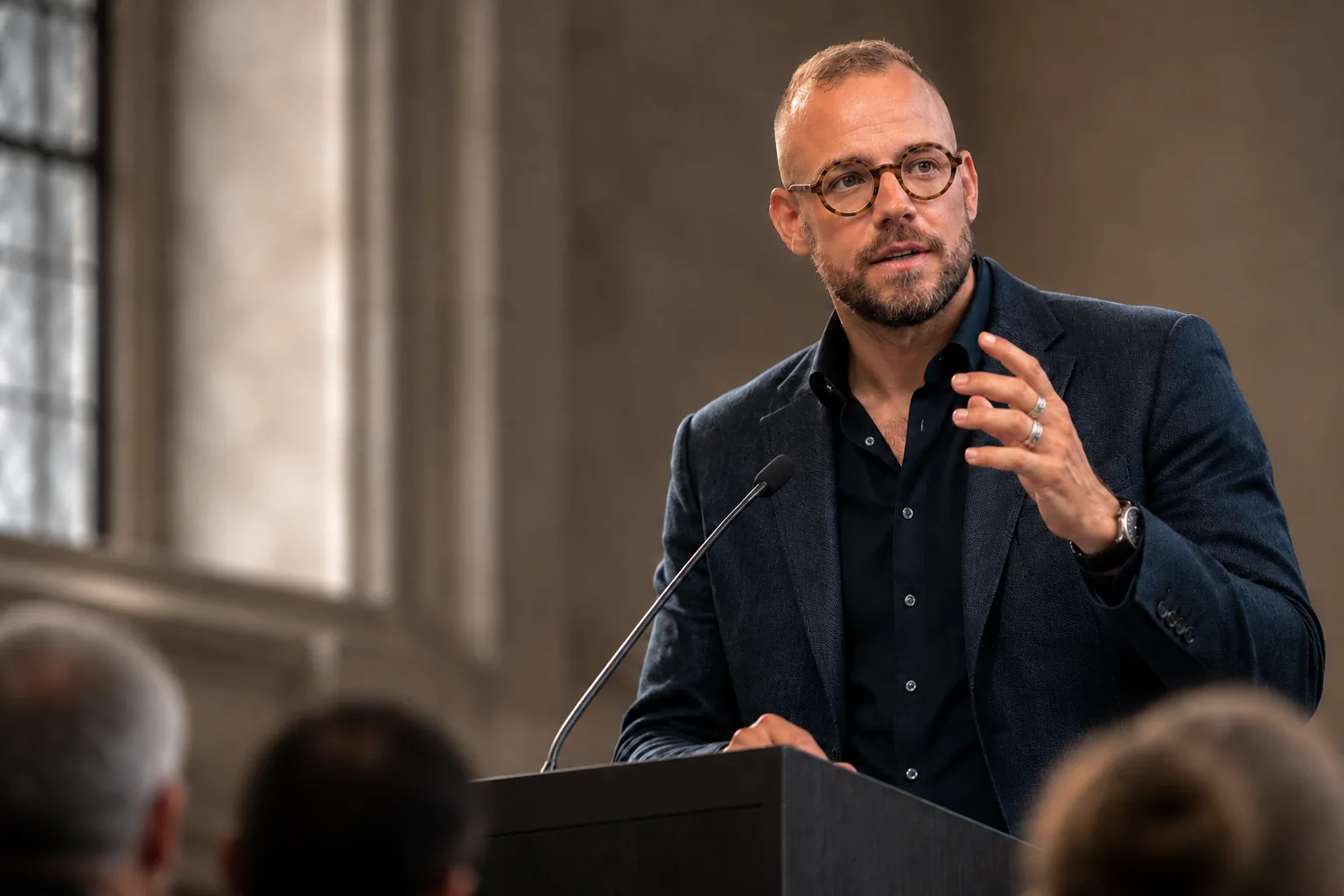
Flavio A. Geisshuesler speaking at a lectern before an audience.

Flavio on ABC Radio National

Flavio on ABC Radio National

Flavio joined James Carleton and Michael Muthukrishna on God Forbid to discuss AI and religious imagination: the beliefs, promises and fears shaping our technological future.

The AI Apocalypse: Human salvation or human extinction?

God Forbid · ABC Radio National · · 54:36

01Films

Recorded talks.

Read the transcript

For about a century, organizations rewarded one thing above everything else: the straight line. Be predictable, be consistent, do it the same way every time. And it worked, because predictability was scarce, and so we paid well for it.

Now, that is over. Anything predictable is now close to free. A machine does it faster than you, and it does it at three in the morning. So the premium moves, and it moves to exactly the territory we spent a hundred years training out of people: ambiguity, contradiction, emotion, wandering attention, the willingness to carry a moral risk instead of handing it off. On a performance review, every one of those looks like a defect. Now, every one of them is the part of you a model cannot replicate.

In 1971, the organizational theorist James March argued that companies needed a technology of foolishness. Most of them built the opposite. They can’t afford that anymore.

I’m a historian of religion, so I recognize the two boldest and loudest stories about AI. One is an apocalypse. The other is a paradise. Both let you skip the thinking. The interesting ground is in between, and that’s where leadership actually happens.

AI is built to predict. Leadership begins there where prediction ends.

The Straight Line Is Free, in 90 seconds

My flagship keynote in brief: why a century of rewarding the predictable is ending, and what leaders must still judge for themselves.

Read the transcript

What people need today is not calm. What they need is the capacity to act well under conditions of radical uncertainty.

I’m currently working on a book project that focuses on the activating and world-engaging dimensions of Buddhist meditation. In fact, I believe that particularly the tantric traditions have never really been about retreating from the world, but much rather about meeting it with clarity, with courage, with skill. And I think that this matters right now, probably more than ever before.

We’re living through a period of tremendous civilizational transformation. They need to be able to thrive in change. And they need to be able to take decisions in moments when it feels like the ground is moving below their feet.

And so the Buddhist traditions have been refining exactly these sorts of capacities for the last two and a half thousand years. And so part of my work here is bringing those types of resources into the present moment.

On screen: key words as captions, an animated statue of the Buddha, Earth at night, the Frontier supercomputer, a glacier (1985 → 2022), the Quadrangle of the University of Sydney, and murals of the Lukhang Temple, Lhasa. At the end: Invite Flavio to speak, flaviogeisshuesler.com/speaking, then a short outtake.

Photograph of the Frontier supercomputer: “Frontier Supercomputer (2) (opens in a new tab)” by OLCF at ORNL, CC BY 2.0 (opens in a new tab).

What people need today

A short film on meditation, uncertainty, and the limits of calm, from my current book project. 1 min 9 s.

Read the transcript

My heart is pumping, and I’m quite nervous. My mind is jumping around like a monkey from one branch to the next on a tree. Zipper, meditation, presentation, cappuccino, pizza. Always go to the pizza at the end. This is my mind.

I am trained as a historian of Indo-Tibetan religions, which means that I study very old texts that are written in Sanskrit and in Tibetan languages. And meditation has become one of our main means in our society to deal with stress. How meditation, or mindfulness meditation, works is by focusing one’s attention on an object, such as the natural flow of our breath. In a way, what meditation does is it disattends to these discursive thoughts that keep running through our minds, and it disrupts this identification with the monkey mind. We slow down, we get present-centered, and the monkey, in a way, relaxes. And so we can do this together right now, just for one second maybe. All of us just close our eyes, take a deep breath, and just feel our bodies in this very moment.

Now, this kind of felt good to me. I’m here to introduce a new paradigm of meditation research. These practices are usually marked by a very open, spacious, and kind of unstructured approach to reality. Here, we find meditators, like here, sitting on top of mountains, on the slopes of mountains, and they gaze into the blue skies for extended periods of time. And what happens is that as they do this, they start to perceive certain things. Visions start to come up quite naturally and automatically. And so I call these practices participant-spontaneous forms of meditation, because it’s as if by looking at reality in an unstructured way, reality itself grips us, or it manifests to us in an automatic way, and we start to appreciate things that we haven’t seen before.

This, too, can be done right now, right here. I mean, all of us can just let our gazes kind of fly across the panorama of this room, and you’ll see stuff you haven’t seen before. In a way, I believe that these types of techniques and this endless possibility and potential for vision is deeply connected to our passions. Passions, too, cannot be created. We’re usually gripped by our interests. And so in a way, me standing here today is the result of me following my monkey mind and becoming a speaker in front of you, sharing my knowledge with you guys.

I come to the second set of techniques. They usually consist out of two stages. In a first stage, the meditators visualize themselves and they identify with a deity. They do this over and over again, taking on the various characteristics of the god, like here, for example, in this mandala. And then in a second stage, they take on this identity, they embody it, and they act it out, and they perform various physical practices. And so these techniques I define as predictive-executive forms of meditation, because here we’re no longer participating in this kind of natural unfolding of reality, but much rather we’re setting ourselves up to take on a specific identity, we apply it, and then we test it in reality.

And so in a way, this too can be related to my experience standing in front of you right now. I remember when I first started out lecturing, I had a course of 140 students at the University of Virginia before I even finished a PhD, and I was so nervous that I kind of crafted myself this Flavio lecturer personality, and I was like, “Fact one, fact two, fact three.” It was like a reading, or a speaking Wikipedia entry. There was hardly any presence in that, the poor students. But it was over time, as I was practicing and repeating and kind of getting comfortable with this persona that I’ve crafted, that I was able to integrate form and freedom, structure and spontaneity, this public persona and the more intimate sense of self, which I hope is flowing through this talk today.

Become the Monkey! A New Paradigm for Meditation Research

Research lecture, Azrieli Fellows Program, 2022. On the experimental and disruptive side of meditation and what it means for meditation research.

Watch the full lecture (21 min) on YouTube (opens in a new tab)
Read the transcript

So you can say, “Hey, this is horrible. We need to stop this. I will never, ever use AI. I’m throwing away my phone.” As soon as you turn on your phone, you’re using AI, right? People underestimate the pervasiveness of this technology.

But the point is, you have people who say, “Let’s return to the human”: restore presence, authorship, embodiment, slow reading, ethical judgment. I mean, this is my world, right? I am the humanities guy. I have two PhDs in the humanities. If you go on LinkedIn today, you have a lot of people that say, “Ah, the humanities, they will save us,” right?

But the secret is, and nobody talks about this, and nobody wants to talk about this, because the only thing that they’re not critical of is, in a way, their own thinking: the humanities, with the anti-foundationalist turn since the ’50s, ’60s, what is the French theory in France, has destroyed any sort of clear human value. Any sort of humanistic anchor that might have been there has been destroyed. And in many ways, if you read Barthes or Foucault, or you read Derrida, and it starts with Saussure, if you read these people, you can see how AI is having a field day with it. It is a dream.

If reality is completely detached from the text, and the text is just floating on top, and it’s authorless in a way, what is AI doing? It’s like, “Oh yeah, this is my world. Let’s go.” Right? This is a collaboration. Nobody’s talking about it, but the humanities are very much involved in this process, and they are not the solution to this problem. Believe me.

On screen, the film names the steps of the argument: the limits of refusal; the promise of a “return to the human”; a critique from within; the humanistic anchor; the intellectual lineage of Roland Barthes, Michel Foucault, Jacques Derrida and Ferdinand de Saussure; text without an author; and the consequence: the humanities are involved in the process they seek to resist.

Can the humanities save us from AI?

Minds and Intelligences Research Centre, Macquarie University, May 2026 1 min 26 s

I wrote an entire chapter on this questionErratic Intelligence · Chapter 7, “The Accomplice” (opens in a new tab)

02Keynotes

Four talks, one inquiry.

Each talk brings the history of religions to a question artificial intelligence has made urgent, and each is shaped around the audience and the question it needs to confront.

Flagship keynote From Erratic Intelligence (opens in a new tab)

The Straight Line Is Free

For a century, organizations rewarded what was predictable. Machines now produce the predictable almost for free, and value moves to what that century trained out of people: ambiguity, wandering attention, and the willingness to carry moral risk. As a historian of religions, I know how old the opposite temptation is: to hand our judgment to whatever speaks with the authority of prediction. Croesus trusted the oracle at Delphi and lost an empire. Keith Jarrett, handed a barely playable piano in Cologne, gave his most celebrated concert. Leaders leave with a sharper sense of where a pattern no longer fits reality, and of what they must still judge for themselves.

For conferences, boards, leadership teams, and universities.

Given at the Minds and Intelligences Research Centre, Macquarie University, in May 2026.

Watch it in 90 seconds
Execution needs order. Discovery needs permission to depart from it.

Converge · Repeat · Optimize

Predictable.

Fast. Repeatable. Legible.It follows a path the system already knows how to reward. Essential for execution; dangerous as a complete theory of human value.

Wander · Risk · Discover

Erratic

Curious. Deviating. Responsible.It stays with the unwelcome question and risks an answer the average cannot yet defend. Essential for finding a future worth executing.

Deeper thinking

The End of the World Is a Very Old Story

Why the loudest stories about AI are religious ones.

AI arrives wrapped in two of the oldest stories people tell about a new power: that it will end the world, or save it. As a historian of religions, I read them as I would any apocalypse: who tells it, what it asks of its believers, and what it keeps out of view. The scariest story about AI is also the most flattering one to the people building it. The keynote draws on Ernesto de Martino, whose work on cultures facing the end of their world was the subject of my first book, and leads a room out of both panic and hype, into the colorful zones between them, where real decisions about AI get made. It also draws on my current research on the religious grammars of artificial intelligence.

Best for: conferences, universities, public lectures and leadership retreats

Related broadcast: God Forbid · ABC Radio National · . Flavio joined James Carleton and Michael Muthukrishna on God Forbid to discuss AI and religious imagination: the beliefs, promises and fears shaping our technological future.

AI at work

The Cuckoo in the Loop

How AI replaces you without taking your job.

An organization can keep producing excellent work while it quietly stops producing the people who could one day lead it. AI makes that easy. Output rises and jobs stay, but the junior lawyer no longer writes the bad first draft, and the mistakes that used to form the next generation are absorbed by a system that doesn’t need them. A cuckoo works the same way: the host bird has the most productive season of her life feeding a chick that isn’t hers, and her own young never fledge. The keynote shows where this is happening, and how to decide what to automate, augment, protect, prohibit and refuse. It draws on the second volume of the Technopsychology Trilogy, now in writing, and on my teaching, where students learn to use AI while keeping their academic independence.

Best for: leadership teams, professional firms, HR and learning leaders, and universities

Explorative AI

The Polyphonic War Room

Build a room where the wrong answer can’t survive unchallenged.

Ask AI about a hard decision and you get one fluent answer. That’s the problem. This keynote uses the machine the other way round, to disrupt a plan before reality does. In the polyphonic war room, several AI agents take distinct stances on the same decision, among them an optimizer, a regulator, a dissenter and a voice for the people the decision will land on, and each is tasked with surfacing what the others suppress. The idea draws on the Russian literary theorist Mikhail Bakhtin, who read Dostoevsky’s novels as worlds where no single voice is allowed to end the conversation. What comes out is a map of where the real trade-offs sit, and the judgment stays with the people in the room.

Best for: strategy offsites, boards, and innovation and AI teams

From Erratic Intelligence (opens in a new tab)

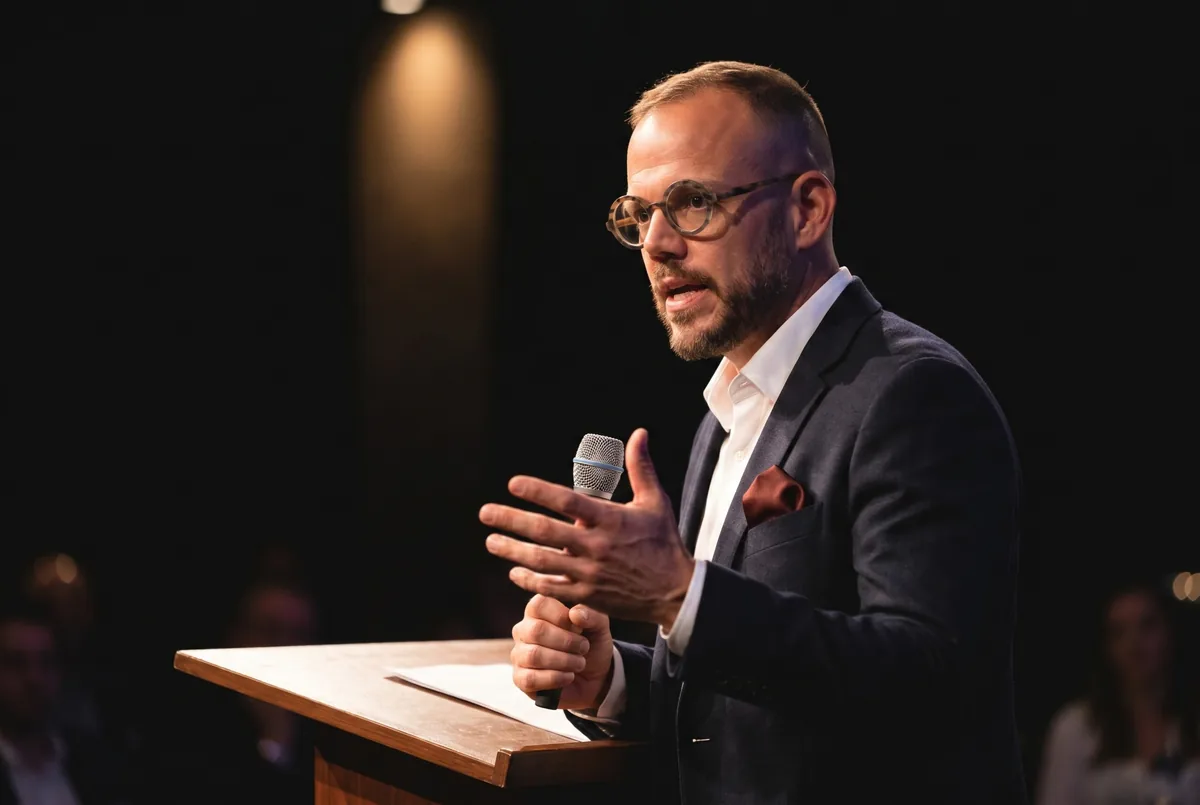
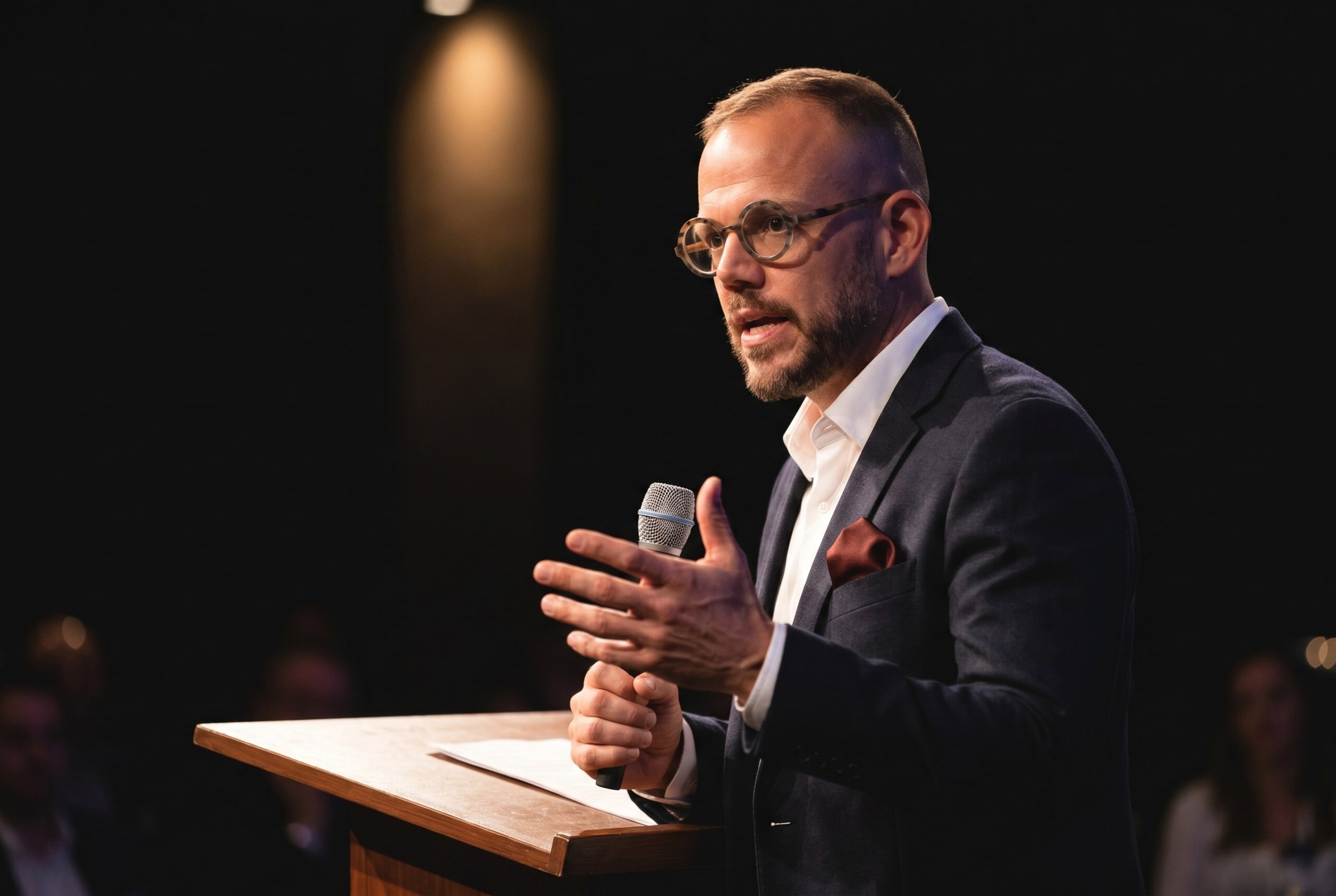
Flavio A. Geisshuesler speaking at a microphone, with one hand extended.

03Audiences

From the room.

“He spent forty-five minutes arguing that our biggest efficiency win was a liability, and by the end our CFO agreed with him. The leadership team was still arguing about it in the bar two hours later.”

“Uncomfortable in the way you actually want. Our partners spent the afternoon session arguing about whether we still know how to make a partner. Nobody has asked that here in a decade.”

“I have booked a lot of closing keynotes and most of them are a victory lap. People stayed in the hall afterwards. Several of them were crying, which I did not expect from a technology conference.”

“My thanks to Flavio for the insightful (and energetic!) talk.”

Audience member Macquarie University
Public response (opens in a new tab)

04The record

Selected lectures and papers.

  1. Erratic Intelligence: AI, Religion, and the Future of the Human. Minds and Intelligences Research Centre, Macquarie University, Sydney, May 2026.
  2. Roundtable: The Future of Contemplation. University of Sydney, October 2025.
  3. Beyond Mindfulness: Empowering Leadership with Tibetan Buddhist Wisdom. University of Sydney Alumni Festival, November 2024.
  4. Cosmic Eggs, Domesticated Sheep, and Flying Kings. 16th Seminar of the International Association for Tibetan Studies, Prague, July 2022.
  5. Ernesto de Martino and the Eschatological Turn in Continental Philosophy. University of Cologne, November 2021.
  6. Ernesto de Martino (1908–1965) as a Classic Figure in the Twentieth-Century Study of Religion. Swiss Society for the Study of Religions (SGR–SSSR), Zurich, March 2021.
  7. Panel convenor: “Ernesto de Martino’s Multiple Identities.” 16th EASR Conference, Bern, 2018.

05Invitations

Invite Flavio to speak.

Write with the date, the audience, and what you hope the talk will do. Talks run from a 25-minute keynote to a half-day session, in English, German, French, or Italian.

Lectures at universities and research institutes
flavio.geisshuesler@sydney.edu.au
Keynotes, briefings, and other events
contact@flaviogeisshuesler.com

Keynotes and briefings for organizations are arranged independently of my university role.

One-to-one advisory for leaders: Erratic Intelligence (opens in a new tab)

Book media and interviews: the Errāticus Press media page (opens in a new tab)

For organizers

Scholar · Author · Advisor · Speaker

Short biography

Flavio A. Geisshuesler is the Khyentse Macready Senior Lecturer in Tibetan Buddhism in the School of Languages and Cultures at the University of Sydney. He is a historian of religions, author, advisor, and speaker who studies how people are formed and how they change. His work links contemplative traditions, leadership, and the demands AI places on human judgment.

Stage introduction

For The Straight Line Is Free

Our speaker is Flavio A. Geisshuesler, a historian of religions and scholar of Tibetan Buddhism, author and private advisor. He brings two doctorates, an Executive MBA from HEC Paris and the INSEAD Coaching Certificate to a question that crosses all his work: how do people learn to see, think and act differently? His keynote is The Straight Line Is Free.

Photographs