Conférences

Mettre les présupposés de la salle à l’épreuve.

Le leadership. L’IA. Et ce que l’histoire des religions en sait.

J’interviens dans des universités, des congrès et des rencontres de dirigeants, et chaque conférence naît de mes recherches : comment les êtres humains affrontent la crise, à quelles autorités ils se fient, et quels récits ils se racontent quand l’avenir devient incertain. Je donne mes conférences en anglais, en allemand, en français et en italien.

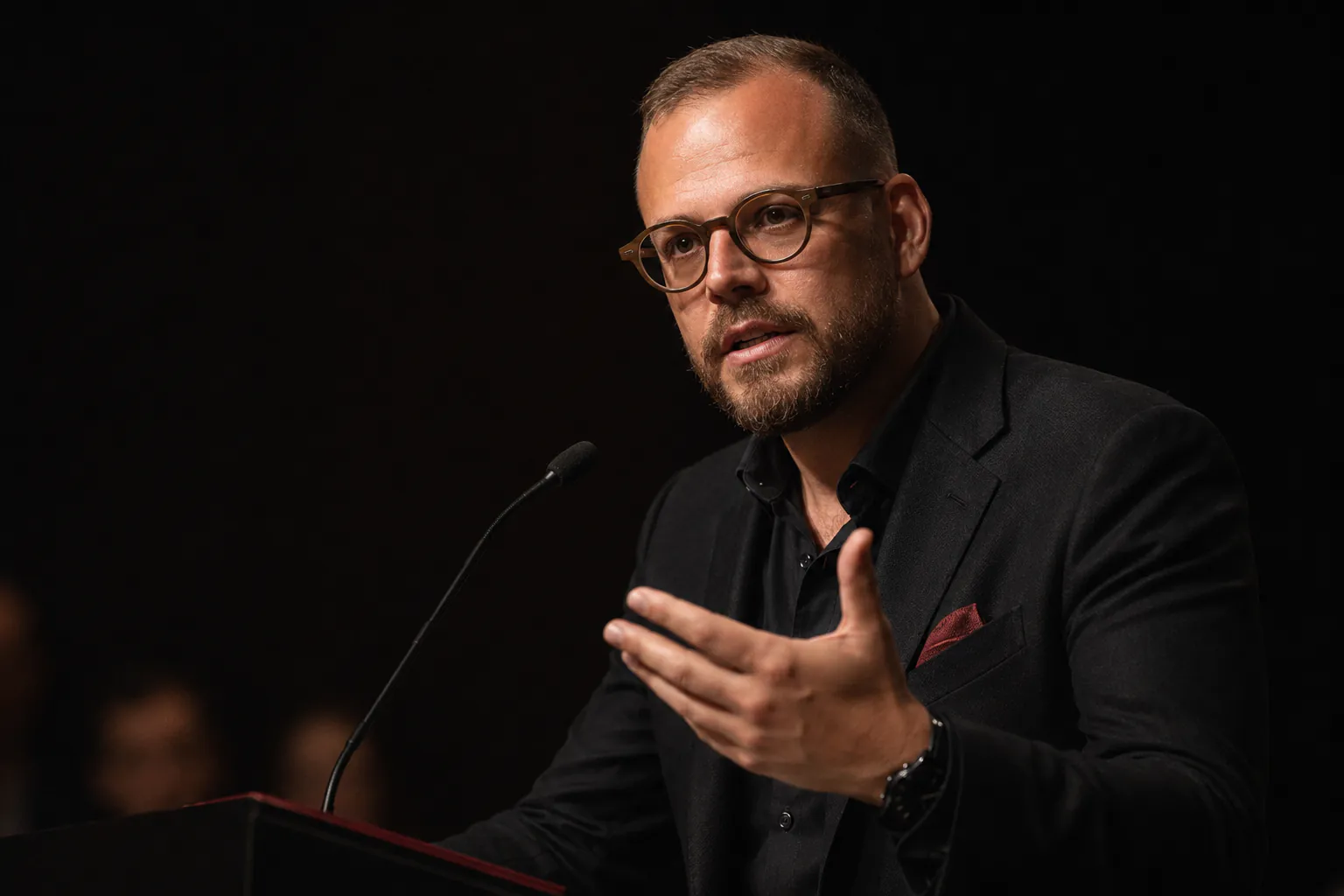
Flavio A. Geisshuesler au pupitre, devant un public.

Flavio sur ABC Radio National

Flavio sur ABC Radio National

Flavio a rejoint James Carleton et Michael Muthukrishna dans God Forbid pour parler de l’IA et de l’imaginaire religieux : les croyances, promesses et peurs qui façonnent notre avenir technologique.

The AI Apocalypse: Human salvation or human extinction?

God Forbid · ABC Radio National · · 54:36

01Films

Conférences filmées.

Lire la transcription (en anglais)

For about a century, organizations rewarded one thing above everything else: the straight line. Be predictable, be consistent, do it the same way every time. And it worked, because predictability was scarce, and so we paid well for it.

Now, that is over. Anything predictable is now close to free. A machine does it faster than you, and it does it at three in the morning. So the premium moves, and it moves to exactly the territory we spent a hundred years training out of people: ambiguity, contradiction, emotion, wandering attention, the willingness to carry a moral risk instead of handing it off. On a performance review, every one of those looks like a defect. Now, every one of them is the part of you a model cannot replicate.

In 1971, the organizational theorist James March argued that companies needed a technology of foolishness. Most of them built the opposite. They can’t afford that anymore.

I’m a historian of religion, so I recognize the two boldest and loudest stories about AI. One is an apocalypse. The other is a paradise. Both let you skip the thinking. The interesting ground is in between, and that’s where leadership actually happens.

AI is built to predict. Leadership begins there where prediction ends.

The Straight Line Is Free, en 90 secondes

Ma keynote phare en bref : pourquoi un siècle passé à récompenser le prévisible touche à sa fin, et ce que les dirigeants doivent encore juger par eux-mêmes.

Lire la transcription (en anglais)

What people need today is not calm. What they need is the capacity to act well under conditions of radical uncertainty.

I’m currently working on a book project that focuses on the activating and world-engaging dimensions of Buddhist meditation. In fact, I believe that particularly the tantric traditions have never really been about retreating from the world, but much rather about meeting it with clarity, with courage, with skill. And I think that this matters right now, probably more than ever before.

We’re living through a period of tremendous civilizational transformation. They need to be able to thrive in change. And they need to be able to take decisions in moments when it feels like the ground is moving below their feet.

And so the Buddhist traditions have been refining exactly these sorts of capacities for the last two and a half thousand years. And so part of my work here is bringing those types of resources into the present moment.

On screen: key words as captions, an animated statue of the Buddha, Earth at night, the Frontier supercomputer, a glacier (1985 → 2022), the Quadrangle of the University of Sydney, and murals of the Lukhang Temple, Lhasa. At the end: Invite Flavio to speak, flaviogeisshuesler.com/speaking, then a short outtake.

Photographie du supercalculateur Frontier : « Frontier Supercomputer (2) (s’ouvre dans un nouvel onglet) » par l’OLCF à l’ORNL, CC BY 2.0 (s’ouvre dans un nouvel onglet).

What people need today

Un court film sur la méditation, l’incertitude et les limites du calme, tiré de mon projet de livre en cours. 1 min 9 s.

Lire la transcription (en anglais)

My heart is pumping, and I’m quite nervous. My mind is jumping around like a monkey from one branch to the next on a tree. Zipper, meditation, presentation, cappuccino, pizza. Always go to the pizza at the end. This is my mind.

I am trained as a historian of Indo-Tibetan religions, which means that I study very old texts that are written in Sanskrit and in Tibetan languages. And meditation has become one of our main means in our society to deal with stress. How meditation, or mindfulness meditation, works is by focusing one’s attention on an object, such as the natural flow of our breath. In a way, what meditation does is it disattends to these discursive thoughts that keep running through our minds, and it disrupts this identification with the monkey mind. We slow down, we get present-centered, and the monkey, in a way, relaxes. And so we can do this together right now, just for one second maybe. All of us just close our eyes, take a deep breath, and just feel our bodies in this very moment.

Now, this kind of felt good to me. I’m here to introduce a new paradigm of meditation research. These practices are usually marked by a very open, spacious, and kind of unstructured approach to reality. Here, we find meditators, like here, sitting on top of mountains, on the slopes of mountains, and they gaze into the blue skies for extended periods of time. And what happens is that as they do this, they start to perceive certain things. Visions start to come up quite naturally and automatically. And so I call these practices participant-spontaneous forms of meditation, because it’s as if by looking at reality in an unstructured way, reality itself grips us, or it manifests to us in an automatic way, and we start to appreciate things that we haven’t seen before.

This, too, can be done right now, right here. I mean, all of us can just let our gazes kind of fly across the panorama of this room, and you’ll see stuff you haven’t seen before. In a way, I believe that these types of techniques and this endless possibility and potential for vision is deeply connected to our passions. Passions, too, cannot be created. We’re usually gripped by our interests. And so in a way, me standing here today is the result of me following my monkey mind and becoming a speaker in front of you, sharing my knowledge with you guys.

I come to the second set of techniques. They usually consist out of two stages. In a first stage, the meditators visualize themselves and they identify with a deity. They do this over and over again, taking on the various characteristics of the god, like here, for example, in this mandala. And then in a second stage, they take on this identity, they embody it, and they act it out, and they perform various physical practices. And so these techniques I define as predictive-executive forms of meditation, because here we’re no longer participating in this kind of natural unfolding of reality, but much rather we’re setting ourselves up to take on a specific identity, we apply it, and then we test it in reality.

And so in a way, this too can be related to my experience standing in front of you right now. I remember when I first started out lecturing, I had a course of 140 students at the University of Virginia before I even finished a PhD, and I was so nervous that I kind of crafted myself this Flavio lecturer personality, and I was like, “Fact one, fact two, fact three.” It was like a reading, or a speaking Wikipedia entry. There was hardly any presence in that, the poor students. But it was over time, as I was practicing and repeating and kind of getting comfortable with this persona that I’ve crafted, that I was able to integrate form and freedom, structure and spontaneity, this public persona and the more intimate sense of self, which I hope is flowing through this talk today.

Become the Monkey! A New Paradigm for Meditation Research

Conférence de recherche, Azrieli Fellows Program, 2022. Sur la dimension expérimentale et déstabilisante de la méditation, et sur ce qu’elle implique pour la recherche sur la méditation.

Voir la conférence complète (21 min) sur YouTube (s’ouvre dans un nouvel onglet)
Lire la transcription (en anglais)

So you can say, “Hey, this is horrible. We need to stop this. I will never, ever use AI. I’m throwing away my phone.” As soon as you turn on your phone, you’re using AI, right? People underestimate the pervasiveness of this technology.

But the point is, you have people who say, “Let’s return to the human”: restore presence, authorship, embodiment, slow reading, ethical judgment. I mean, this is my world, right? I am the humanities guy. I have two PhDs in the humanities. If you go on LinkedIn today, you have a lot of people that say, “Ah, the humanities, they will save us,” right?

But the secret is, and nobody talks about this, and nobody wants to talk about this, because the only thing that they’re not critical of is, in a way, their own thinking: the humanities, with the anti-foundationalist turn since the ’50s, ’60s, what is the French theory in France, has destroyed any sort of clear human value. Any sort of humanistic anchor that might have been there has been destroyed. And in many ways, if you read Barthes or Foucault, or you read Derrida, and it starts with Saussure, if you read these people, you can see how AI is having a field day with it. It is a dream.

If reality is completely detached from the text, and the text is just floating on top, and it’s authorless in a way, what is AI doing? It’s like, “Oh yeah, this is my world. Let’s go.” Right? This is a collaboration. Nobody’s talking about it, but the humanities are very much involved in this process, and they are not the solution to this problem. Believe me.

On screen, the film names the steps of the argument: the limits of refusal; the promise of a “return to the human”; a critique from within; the humanistic anchor; the intellectual lineage of Roland Barthes, Michel Foucault, Jacques Derrida and Ferdinand de Saussure; text without an author; and the consequence: the humanities are involved in the process they seek to resist.

Can the humanities save us from AI?

Minds and Intelligences Research Centre, Université Macquarie, mai 2026 1 min 26 s

J’ai consacré tout un chapitre à cette questionErratic Intelligence · Chapitre 7, « The Accomplice » (s’ouvre dans un nouvel onglet)

02Keynotes

Quatre conférences, une seule enquête.

Chaque conférence confronte l’histoire des religions à une question que l’intelligence artificielle a rendue urgente, et chacune est construite autour du public et de la question qu’il doit affronter.

Keynote phare D’après Erratic Intelligence (s’ouvre dans un nouvel onglet)

The Straight Line Is Free

Pendant un siècle, les organisations ont récompensé ce qui était prévisible. Les machines produisent désormais le prévisible presque gratuitement, et la valeur se déplace vers ce que ce siècle s’est appliqué à faire disparaître chez les individus : l’ambiguïté, l’attention vagabonde et la disposition à porter un risque moral. En historien des religions, je sais combien la tentation inverse est ancienne : confier notre jugement à tout ce qui parle avec l’autorité de la prédiction. Crésus s’est fié à l’oracle de Delphes et a perdu un empire. Keith Jarrett, à qui l’on avait fourni à Cologne un piano à peine jouable, a donné son concert le plus célèbre. Les dirigeants repartent en voyant plus nettement où un schéma ne correspond plus à la réalité, et ce qu’ils doivent encore juger par eux-mêmes.

Pour les congrès, les conseils d’administration, les équipes dirigeantes et les universités.

Donnée au Minds and Intelligences Research Centre de l’Université Macquarie en mai 2026.

La voir en 90 secondes
Exécuter demande de l’ordre. Découvrir demande la liberté de s’en écarter.

Converger · Répéter · Optimiser

Prévisible.

Rapide. Reproductible. Lisible.Elle suit un chemin que le système sait déjà récompenser. Essentielle à l’exécution ; dangereuse comme définition complète de la valeur humaine.

S’aventurer · Risquer · Découvrir

Erratique

Curieuse. Divergente. Responsable.Elle ne lâche pas la question qui dérange et prend le risque d’une réponse que la moyenne ne peut pas encore défendre. Essentielle pour trouver un avenir qui mérite d’être mis en œuvre.

Réflexion de fond

The End of the World Is a Very Old Story

Pourquoi les récits les plus bruyants sur l’IA sont des récits religieux.

L’IA arrive enveloppée de deux des plus anciens récits que l’on raconte sur une puissance nouvelle : elle va mettre fin au monde, ou le sauver. En historien des religions, je les lis comme toute apocalypse : qui la raconte, ce qu’elle exige de ses croyants et ce qu’elle dissimule. Le récit le plus terrifiant sur l’IA est aussi le plus flatteur pour ceux qui la construisent. La keynote s’appuie sur Ernesto de Martino, dont les travaux sur les cultures confrontées à la fin de leur monde ont fait l’objet de mon premier livre. Elle conduit le public hors de la panique comme de l’emballement, vers les zones nuancées qui les séparent, là où se prennent les vraies décisions sur l’IA. Elle s’appuie aussi sur mes recherches actuelles sur les grammaires religieuses de l’intelligence artificielle.

Idéal pour les congrès, les universités, les conférences publiques et les séminaires de dirigeants

Émission sur ce thème: God Forbid · ABC Radio National · . Flavio a rejoint James Carleton et Michael Muthukrishna dans God Forbid pour parler de l’IA et de l’imaginaire religieux : les croyances, promesses et peurs qui façonnent notre avenir technologique.

L’IA au travail

The Cuckoo in the Loop

Comment l’IA vous remplace sans prendre votre emploi.

Une organisation peut continuer à produire un excellent travail tout en cessant, sans bruit, de former les personnes qui pourraient un jour la diriger. L’IA facilite ce processus. La production augmente et les emplois restent, mais le jeune avocat n’écrit plus son mauvais premier brouillon, et les erreurs qui formaient la génération suivante sont absorbées par un système qui n’en a pas besoin. Le coucou fonctionne de la même façon : l’oiseau hôte vit la saison la plus productive de sa vie en nourrissant un petit qui n’est pas le sien, tandis que ses propres petits ne prennent jamais leur envol. La keynote montre où cela se produit et comment décider de ce qu’il faut automatiser, augmenter, protéger, interdire ou refuser. Elle s’appuie sur le deuxième volume de la Technopsychology Trilogy, en cours d’écriture, et sur mon enseignement, où les étudiant·es apprennent à utiliser l’IA tout en préservant leur autonomie intellectuelle.

Idéal pour les équipes dirigeantes, les cabinets, les responsables RH et formation, et les universités

L’IA exploratoire

The Polyphonic War Room

Créez un espace où aucune mauvaise réponse ne passe sans être contestée.

Interrogez l’IA sur une décision difficile : elle vous donne une seule réponse, parfaitement fluide. C’est bien le problème. Cette keynote utilise la machine dans l’autre sens, pour ébranler un plan avant que la réalité s’en charge. Dans cet exercice de stratégie à plusieurs voix, divers agents d’IA prennent des positions distinctes sur une même décision, notamment un optimiseur, un régulateur, une voix dissidente et une voix pour les personnes qui en subiront les effets. Chacun doit faire apparaître ce que les autres taisent. L’idée s’inspire du théoricien russe de la littérature Mikhaïl Bakhtine, qui lisait les romans de Dostoïevski comme des mondes où aucune voix ne peut clore seule la conversation. Il en ressort une carte des véritables arbitrages à faire, tandis que le jugement reste entre les mains des personnes présentes.

Idéal pour les séminaires stratégiques, les conseils d’administration et les équipes innovation et IA

D’après Erratic Intelligence (s’ouvre dans un nouvel onglet)

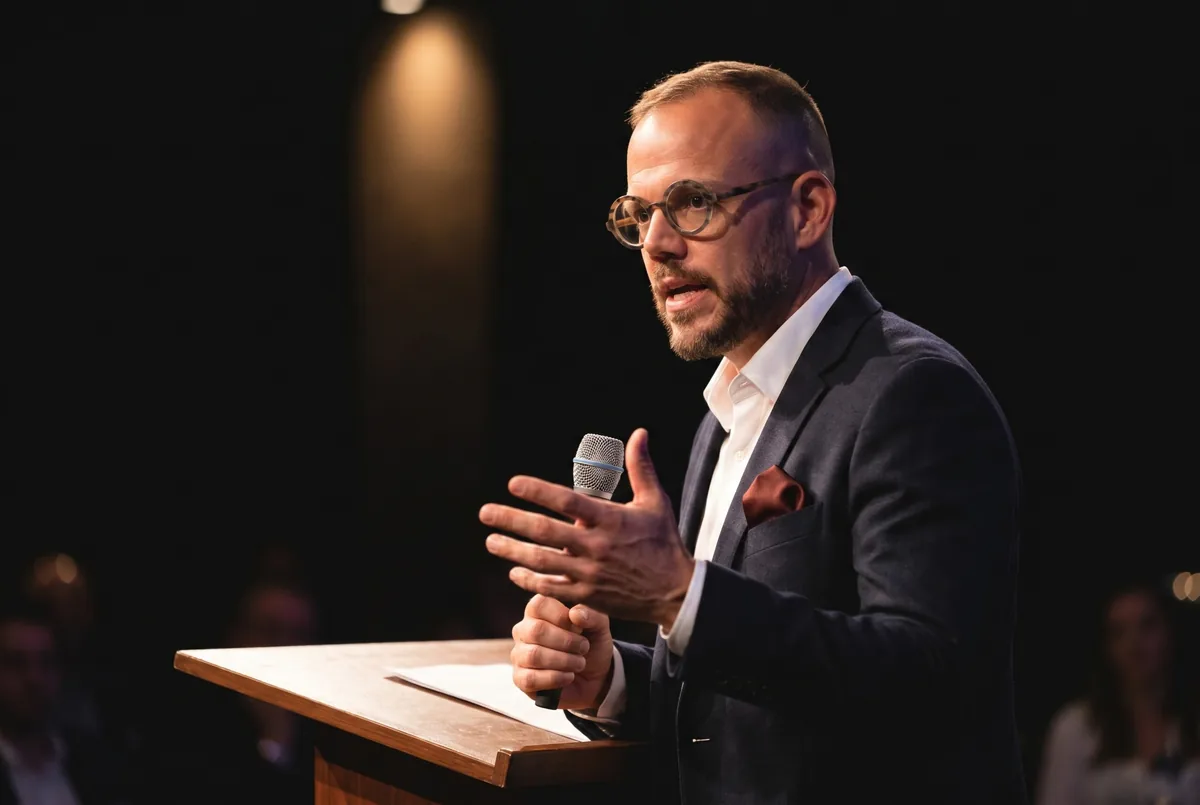
Flavio A. Geisshuesler parlant au micro, une main tendue.

03Publics

Échos de la salle.

“He spent forty-five minutes arguing that our biggest efficiency win was a liability, and by the end our CFO agreed with him. The leadership team was still arguing about it in the bar two hours later.”

“Uncomfortable in the way you actually want. Our partners spent the afternoon session arguing about whether we still know how to make a partner. Nobody has asked that here in a decade.”

“I have booked a lot of closing keynotes and most of them are a victory lap. People stayed in the hall afterwards. Several of them were crying, which I did not expect from a technology conference.”

“My thanks to Flavio for the insightful (and energetic!) talk.”

Membre du public Université Macquarie
Réaction du public (s’ouvre dans un nouvel onglet)

04Références

Choix de conférences et de communications.

  1. Erratic Intelligence: AI, Religion, and the Future of the Human. Minds and Intelligences Research Centre, Université Macquarie, Sydney, mai 2026.
  2. Table ronde : The Future of Contemplation. Université de Sydney, octobre 2025.
  3. Beyond Mindfulness: Empowering Leadership with Tibetan Buddhist Wisdom. Alumni Festival de l’Université de Sydney, novembre 2024.
  4. Cosmic Eggs, Domesticated Sheep, and Flying Kings. 16e séminaire de l’International Association for Tibetan Studies, Prague, juillet 2022.
  5. Ernesto de Martino and the Eschatological Turn in Continental Philosophy. Université de Cologne, novembre 2021.
  6. Ernesto de Martino (1908–1965) as a Classic Figure in the Twentieth-Century Study of Religion. Société suisse pour la science des religions (SGR–SSSR), Zurich, mars 2021.
  7. Organisation d’un panel : « Ernesto de Martino’s Multiple Identities ». 16e congrès de l’EASR, Berne, 2018.

05Invitations

Inviter Flavio à intervenir.

Écrivez en indiquant la date, le public et ce que vous attendez de l’intervention. Les interventions vont d’une keynote de 25 minutes à une session d’une demi-journée, en anglais, en allemand, en français ou en italien.

Conférences dans les universités et les instituts de recherche
flavio.geisshuesler@sydney.edu.au
Keynotes, présentations ciblées et autres événements
contact@flaviogeisshuesler.com

Les keynotes et les présentations ciblées destinées aux organisations sont convenues indépendamment de ma fonction universitaire.

Conseil individuel pour dirigeants : Erratic Intelligence (s’ouvre dans un nouvel onglet)

Presse et entretiens autour du livre : la page médias d’Errāticus Press (s’ouvre dans un nouvel onglet)

Pour les organisateurs

Chercheur · Auteur · Conseiller · Conférencier

Biographie courte

Flavio A. Geisshuesler est Khyentse Macready Senior Lecturer in Tibetan Buddhism à la School of Languages and Cultures de l’Université de Sydney. Historien des religions, auteur, conseiller et conférencier, il étudie comment les êtres humains se forment et comment ils changent. Son travail relie les traditions contemplatives, le leadership et les exigences que l’IA impose au discernement humain.

Présentation du conférencier

Pour The Straight Line Is Free

Notre conférencier est Flavio A. Geisshuesler, historien des religions et spécialiste du bouddhisme tibétain, auteur et conseiller auprès de dirigeants. Avec deux doctorats, un Executive MBA d’HEC Paris et le certificat de coaching de l’INSEAD, il aborde une question qui traverse tout son travail : comment apprend-on à voir, à penser et à agir autrement ? Sa keynote s’intitule « The Straight Line Is Free ».

Photographies