Interventi

Mettere le certezze della sala alla prova.

Leadership. IA. E ciò che la storia delle religioni sa di entrambe.

Intervengo in università, convegni e incontri per dirigenti, e ogni conferenza nasce dalla mia ricerca: come le persone affrontano la crisi, a chi si affidano come autorità e quali storie raccontano quando il futuro si fa incerto. Parlo in inglese, tedesco, francese e italiano.

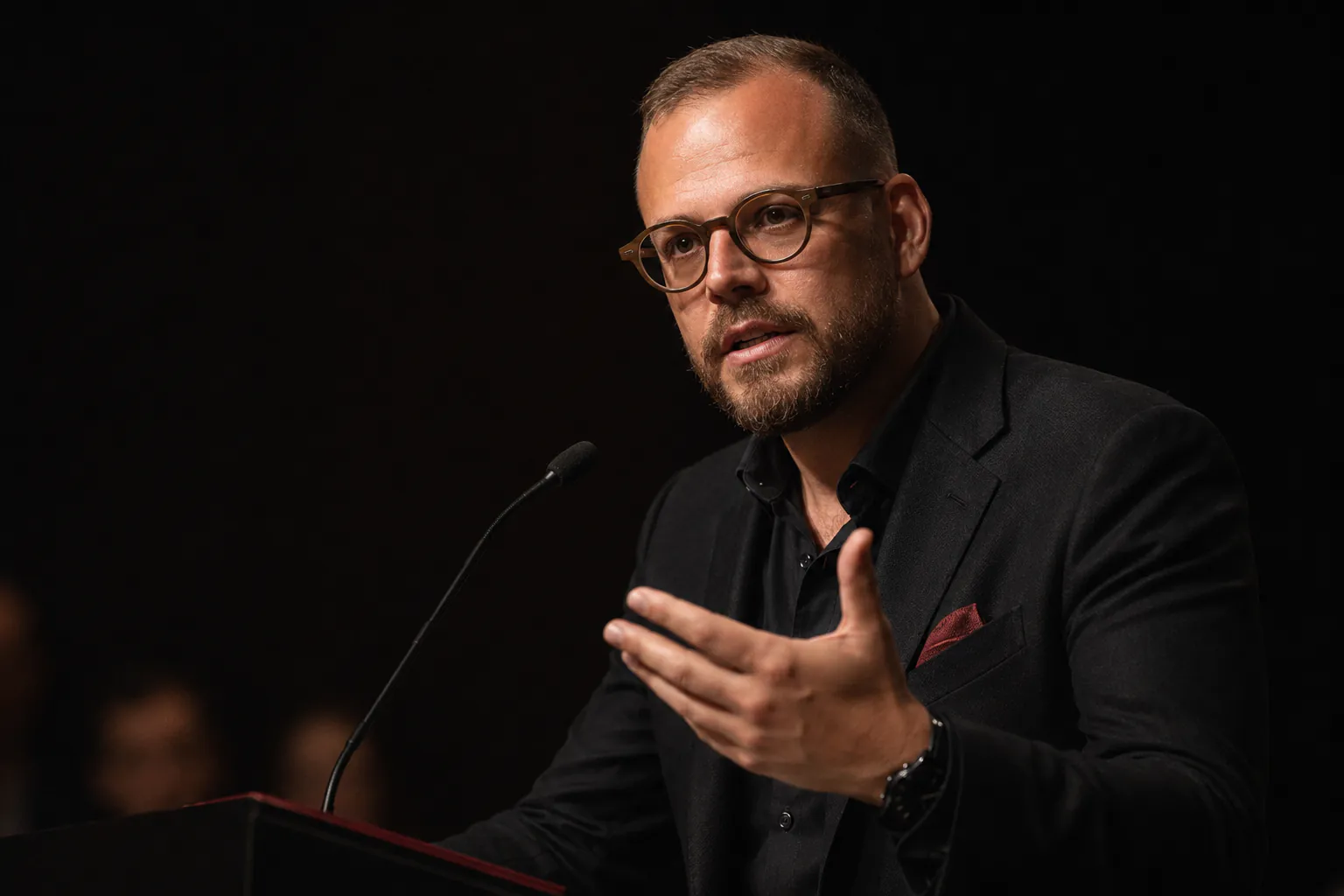
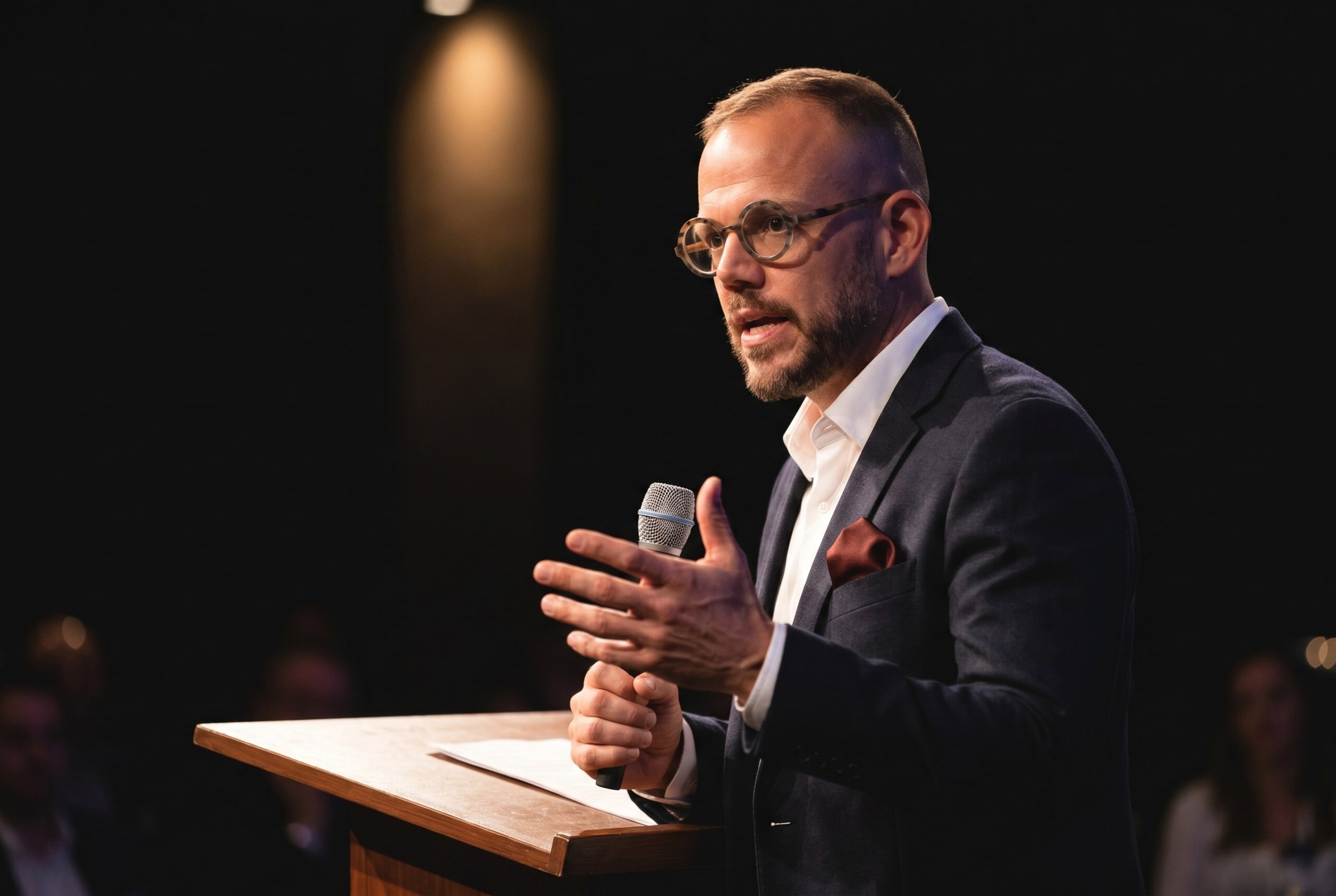
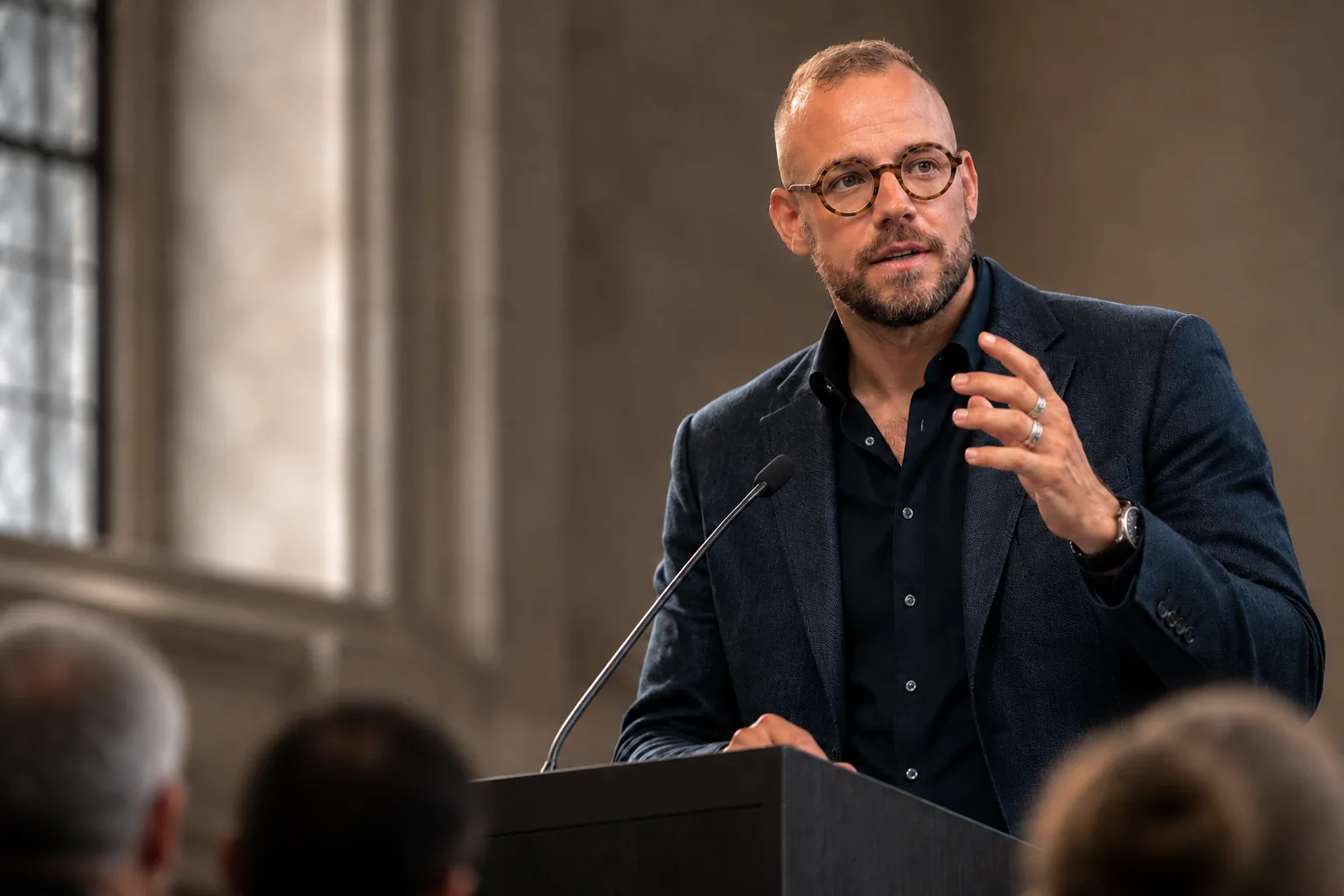
Flavio A. Geisshuesler parla a un leggio davanti al pubblico.

Flavio su ABC Radio National

Flavio su ABC Radio National

Flavio ha dialogato con James Carleton e Michael Muthukrishna a God Forbid sull’IA e l’immaginario religioso: le convinzioni, le promesse e le paure che plasmano il nostro futuro tecnologico.

The AI Apocalypse: Human salvation or human extinction?

God Forbid · ABC Radio National · · 54:36

01Film

Conferenze registrate.

Leggi la trascrizione (in inglese)

For about a century, organizations rewarded one thing above everything else: the straight line. Be predictable, be consistent, do it the same way every time. And it worked, because predictability was scarce, and so we paid well for it.

Now, that is over. Anything predictable is now close to free. A machine does it faster than you, and it does it at three in the morning. So the premium moves, and it moves to exactly the territory we spent a hundred years training out of people: ambiguity, contradiction, emotion, wandering attention, the willingness to carry a moral risk instead of handing it off. On a performance review, every one of those looks like a defect. Now, every one of them is the part of you a model cannot replicate.

In 1971, the organizational theorist James March argued that companies needed a technology of foolishness. Most of them built the opposite. They can’t afford that anymore.

I’m a historian of religion, so I recognize the two boldest and loudest stories about AI. One is an apocalypse. The other is a paradise. Both let you skip the thinking. The interesting ground is in between, and that’s where leadership actually happens.

AI is built to predict. Leadership begins there where prediction ends.

The Straight Line Is Free, in 90 secondi

Il mio keynote principale in breve: perché un secolo che ha premiato il prevedibile sta finendo, e che cosa i leader devono ancora giudicare da sé.

Leggi la trascrizione (in inglese)

What people need today is not calm. What they need is the capacity to act well under conditions of radical uncertainty.

I’m currently working on a book project that focuses on the activating and world-engaging dimensions of Buddhist meditation. In fact, I believe that particularly the tantric traditions have never really been about retreating from the world, but much rather about meeting it with clarity, with courage, with skill. And I think that this matters right now, probably more than ever before.

We’re living through a period of tremendous civilizational transformation. They need to be able to thrive in change. And they need to be able to take decisions in moments when it feels like the ground is moving below their feet.

And so the Buddhist traditions have been refining exactly these sorts of capacities for the last two and a half thousand years. And so part of my work here is bringing those types of resources into the present moment.

On screen: key words as captions, an animated statue of the Buddha, Earth at night, the Frontier supercomputer, a glacier (1985 → 2022), the Quadrangle of the University of Sydney, and murals of the Lukhang Temple, Lhasa. At the end: Invite Flavio to speak, flaviogeisshuesler.com/speaking, then a short outtake.

Fotografia del supercomputer Frontier: «Frontier Supercomputer (2) (si apre in una nuova scheda)» di OLCF presso l’ORNL, CC BY 2.0 (si apre in una nuova scheda).

What people need today

Un breve film sulla meditazione, sull’incertezza e sui limiti della calma, dal mio attuale progetto di libro. 1 min 9 s.

Leggi la trascrizione (in inglese)

My heart is pumping, and I’m quite nervous. My mind is jumping around like a monkey from one branch to the next on a tree. Zipper, meditation, presentation, cappuccino, pizza. Always go to the pizza at the end. This is my mind.

I am trained as a historian of Indo-Tibetan religions, which means that I study very old texts that are written in Sanskrit and in Tibetan languages. And meditation has become one of our main means in our society to deal with stress. How meditation, or mindfulness meditation, works is by focusing one’s attention on an object, such as the natural flow of our breath. In a way, what meditation does is it disattends to these discursive thoughts that keep running through our minds, and it disrupts this identification with the monkey mind. We slow down, we get present-centered, and the monkey, in a way, relaxes. And so we can do this together right now, just for one second maybe. All of us just close our eyes, take a deep breath, and just feel our bodies in this very moment.

Now, this kind of felt good to me. I’m here to introduce a new paradigm of meditation research. These practices are usually marked by a very open, spacious, and kind of unstructured approach to reality. Here, we find meditators, like here, sitting on top of mountains, on the slopes of mountains, and they gaze into the blue skies for extended periods of time. And what happens is that as they do this, they start to perceive certain things. Visions start to come up quite naturally and automatically. And so I call these practices participant-spontaneous forms of meditation, because it’s as if by looking at reality in an unstructured way, reality itself grips us, or it manifests to us in an automatic way, and we start to appreciate things that we haven’t seen before.

This, too, can be done right now, right here. I mean, all of us can just let our gazes kind of fly across the panorama of this room, and you’ll see stuff you haven’t seen before. In a way, I believe that these types of techniques and this endless possibility and potential for vision is deeply connected to our passions. Passions, too, cannot be created. We’re usually gripped by our interests. And so in a way, me standing here today is the result of me following my monkey mind and becoming a speaker in front of you, sharing my knowledge with you guys.

I come to the second set of techniques. They usually consist out of two stages. In a first stage, the meditators visualize themselves and they identify with a deity. They do this over and over again, taking on the various characteristics of the god, like here, for example, in this mandala. And then in a second stage, they take on this identity, they embody it, and they act it out, and they perform various physical practices. And so these techniques I define as predictive-executive forms of meditation, because here we’re no longer participating in this kind of natural unfolding of reality, but much rather we’re setting ourselves up to take on a specific identity, we apply it, and then we test it in reality.

And so in a way, this too can be related to my experience standing in front of you right now. I remember when I first started out lecturing, I had a course of 140 students at the University of Virginia before I even finished a PhD, and I was so nervous that I kind of crafted myself this Flavio lecturer personality, and I was like, “Fact one, fact two, fact three.” It was like a reading, or a speaking Wikipedia entry. There was hardly any presence in that, the poor students. But it was over time, as I was practicing and repeating and kind of getting comfortable with this persona that I’ve crafted, that I was able to integrate form and freedom, structure and spontaneity, this public persona and the more intimate sense of self, which I hope is flowing through this talk today.

Become the Monkey! A New Paradigm for Meditation Research

Conferenza accademica, Azrieli Fellows Program, 2022. Sul lato sperimentale e dirompente della meditazione e su ciò che significa per la ricerca sulla meditazione.

Guarda la conferenza completa (21 min) su YouTube (si apre in una nuova scheda)
Leggi la trascrizione (in inglese)

So you can say, “Hey, this is horrible. We need to stop this. I will never, ever use AI. I’m throwing away my phone.” As soon as you turn on your phone, you’re using AI, right? People underestimate the pervasiveness of this technology.

But the point is, you have people who say, “Let’s return to the human”: restore presence, authorship, embodiment, slow reading, ethical judgment. I mean, this is my world, right? I am the humanities guy. I have two PhDs in the humanities. If you go on LinkedIn today, you have a lot of people that say, “Ah, the humanities, they will save us,” right?

But the secret is, and nobody talks about this, and nobody wants to talk about this, because the only thing that they’re not critical of is, in a way, their own thinking: the humanities, with the anti-foundationalist turn since the ’50s, ’60s, what is the French theory in France, has destroyed any sort of clear human value. Any sort of humanistic anchor that might have been there has been destroyed. And in many ways, if you read Barthes or Foucault, or you read Derrida, and it starts with Saussure, if you read these people, you can see how AI is having a field day with it. It is a dream.

If reality is completely detached from the text, and the text is just floating on top, and it’s authorless in a way, what is AI doing? It’s like, “Oh yeah, this is my world. Let’s go.” Right? This is a collaboration. Nobody’s talking about it, but the humanities are very much involved in this process, and they are not the solution to this problem. Believe me.

On screen, the film names the steps of the argument: the limits of refusal; the promise of a “return to the human”; a critique from within; the humanistic anchor; the intellectual lineage of Roland Barthes, Michel Foucault, Jacques Derrida and Ferdinand de Saussure; text without an author; and the consequence: the humanities are involved in the process they seek to resist.

Can the humanities save us from AI?

Minds and Intelligences Research Centre, Macquarie University, maggio 2026 1 min 26 s

Ho dedicato a questa domanda un intero capitoloErratic Intelligence · Capitolo 7, «The Accomplice» (si apre in una nuova scheda)

02Keynote

Quattro conferenze, un’unica indagine.

Ogni conferenza porta la storia delle religioni a confrontarsi con una domanda che l’intelligenza artificiale ha reso urgente, e ciascuna è modellata sul pubblico e sulla questione che quel pubblico deve affrontare.

Keynote principale Tratto da Erratic Intelligence (si apre in una nuova scheda)

The Straight Line Is Free

Per un secolo le organizzazioni hanno premiato ciò che era prevedibile. Oggi le macchine producono il prevedibile quasi gratis, e il valore si sposta verso ciò che quel secolo ha estirpato dalle persone: l’ambiguità, l’attenzione che vaga e la disponibilità ad assumersi un rischio morale. Da storico delle religioni, so quanto sia antica la tentazione opposta: affidare il nostro giudizio a qualunque cosa parli con l’autorità della previsione. Creso si fidò dell’oracolo di Delfi e perse un impero. Keith Jarrett, che a Colonia si trovò davanti a un pianoforte quasi impossibile da suonare, diede il suo concerto più celebre. I leader ne escono con una percezione più acuta di dove uno schema non corrisponde più alla realtà, e di che cosa devono ancora giudicare da sé.

Per convegni, consigli di amministrazione, gruppi dirigenti e università.

Tenuto al Minds and Intelligences Research Centre della Macquarie University nel maggio 2026.

Guardarlo in 90 secondi
L’esecuzione richiede ordine. La scoperta richiede il permesso di allontanarsene.

Convergere · Ripetere · Ottimizzare

Prevedibile.

Veloce. Ripetibile. Leggibile.Segue un percorso che il sistema sa già premiare. Essenziale per l’esecuzione; pericoloso come teoria complessiva del valore umano.

Vagare · Rischiare · Scoprire

Erratico

Curioso. Divergente. Responsabile.Non abbandona la domanda scomoda e azzarda una risposta che il pensiero medio non sa ancora difendere. Essenziale per trovare un futuro che valga la pena realizzare.

Pensare più a fondo

The End of the World Is a Very Old Story

Perché le narrazioni sull’IA che fanno più rumore sono religiose.

L’IA arriva avvolta in due delle storie più antiche che si raccontano di un nuovo potere: che metterà fine al mondo o che lo salverà. Da storico delle religioni, le leggo come leggerei qualsiasi apocalisse: chi la racconta, che cosa chiede a chi ci crede e che cosa sottrae allo sguardo. La storia più spaventosa sull’IA è anche quella che più lusinga chi costruisce l’IA. Il keynote attinge a Ernesto de Martino, il cui lavoro sulle culture di fronte alla fine del proprio mondo è stato l’oggetto del mio primo libro, e porta il pubblico fuori sia dal panico sia dall’entusiasmo acritico, verso le zone ricche di sfumature che li separano, dove si prendono le vere decisioni sull’IA. Attinge inoltre alla mia ricerca attuale sulle grammatiche religiose dell’intelligenza artificiale.

Ideale per: convegni, università, incontri aperti al pubblico e ritiri per dirigenti

Trasmissione sul tema: God Forbid · ABC Radio National · . Flavio ha dialogato con James Carleton e Michael Muthukrishna a God Forbid sull’IA e l’immaginario religioso: le convinzioni, le promesse e le paure che plasmano il nostro futuro tecnologico.

L’IA al lavoro

The Cuckoo in the Loop

Come l’IA ci sostituisce senza toglierci il lavoro.

Un’organizzazione può continuare a produrre lavoro eccellente mentre, in silenzio, smette di formare le persone che un giorno potrebbero guidarla. L’IA lo rende facile. Si produce di più e i posti di lavoro restano, ma il giovane avvocato non scrive più la prima bozza malriuscita e gli errori che formavano la generazione successiva vengono assorbiti da un sistema che non ne ha bisogno. Il cuculo agisce allo stesso modo: l’uccello che lo accoglie vive la stagione più produttiva della sua vita nutrendo un pulcino che non è suo, mentre i suoi stessi piccoli non spiccano mai il volo. Il keynote mostra dove sta accadendo e come decidere che cosa automatizzare, potenziare, proteggere, vietare e rifiutare. Attinge al secondo volume della Technopsychology Trilogy, in corso di scrittura, e alla mia attività didattica, in cui gli studenti imparano a usare l’IA preservando la propria autonomia accademica.

Ideale per: gruppi dirigenti, studi professionali, responsabili delle risorse umane e della formazione, università

IA esplorativa

The Polyphonic War Room

Creare uno spazio in cui una risposta sbagliata non possa restare incontrastata.

Se si interroga l’IA su una decisione difficile, si ottiene un’unica risposta, ben formulata. È questo il problema. Questo keynote usa la macchina al contrario, per mettere in crisi un piano prima che lo faccia la realtà. Nella war room polifonica, più agenti di IA assumono posizioni distinte sulla stessa decisione: tra loro, chi ottimizza, chi verifica il rispetto delle regole, chi dissente e chi dà voce alle persone su cui ricadrà la decisione; ognuno ha il compito di far emergere ciò che gli altri soffocano. L’idea si ispira al teorico russo della letteratura Michail Bachtin, che leggeva i romanzi di Dostoevskij come mondi in cui a nessuna voce è permesso chiudere da sola la conversazione. Ne emerge una mappa di dove si collocano i veri compromessi, mentre il giudizio resta alle persone presenti nella sala.

Ideale per: incontri strategici fuori sede, consigli d’amministrazione, team di innovazione e IA

Tratto da Erratic Intelligence (si apre in una nuova scheda)

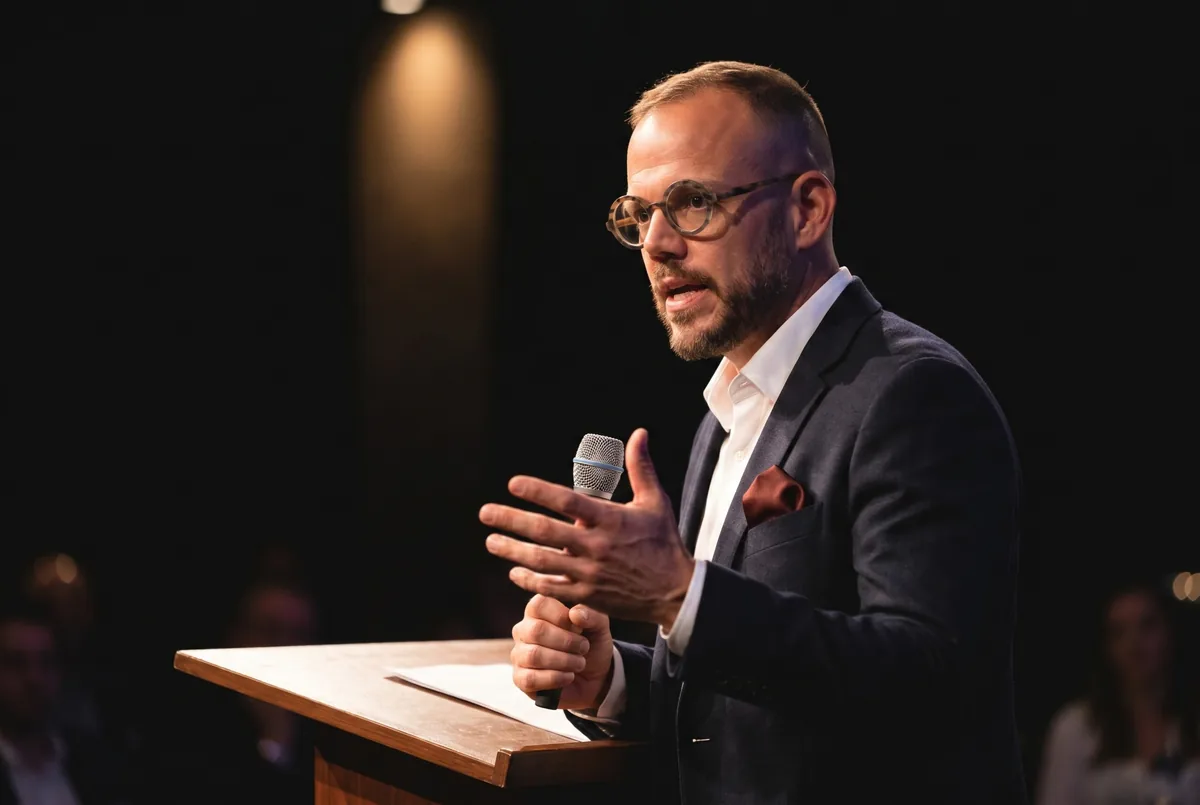
Flavio A. Geisshuesler parla al microfono, con una mano protesa.

03Il pubblico

Dalla sala.

“He spent forty-five minutes arguing that our biggest efficiency win was a liability, and by the end our CFO agreed with him. The leadership team was still arguing about it in the bar two hours later.”

“Uncomfortable in the way you actually want. Our partners spent the afternoon session arguing about whether we still know how to make a partner. Nobody has asked that here in a decade.”

“I have booked a lot of closing keynotes and most of them are a victory lap. People stayed in the hall afterwards. Several of them were crying, which I did not expect from a technology conference.”

“My thanks to Flavio for the insightful (and energetic!) talk.”

Una persona del pubblico Macquarie University
Commento pubblico (si apre in una nuova scheda)

04Archivio

Conferenze e relazioni scelte.

  1. Erratic Intelligence: AI, Religion, and the Future of the Human. Minds and Intelligences Research Centre, Macquarie University, Sydney, maggio 2026.
  2. Tavola rotonda: The Future of Contemplation. Università di Sydney, ottobre 2025.
  3. Beyond Mindfulness: Empowering Leadership with Tibetan Buddhist Wisdom. Alumni Festival dell’Università di Sydney, novembre 2024.
  4. Cosmic Eggs, Domesticated Sheep, and Flying Kings. 16° Seminario dell’International Association for Tibetan Studies, Praga, luglio 2022.
  5. Ernesto de Martino and the Eschatological Turn in Continental Philosophy. Università di Colonia, novembre 2021.
  6. Ernesto de Martino (1908–1965) as a Classic Figure in the Twentieth-Century Study of Religion. Società svizzera per la scienza delle religioni (SGR–SSSR), Zurigo, marzo 2021.
  7. Coordinatore del panel: «Ernesto de Martino’s Multiple Identities». 16° convegno dell’EASR, Berna, 2018.

05Inviti

Invitare Flavio come relatore.

Si prega di scrivere indicando la data, il pubblico e ciò che ci si aspetta dalla conferenza. Le conferenze vanno da un keynote di 25 minuti a una sessione di mezza giornata, in inglese, tedesco, francese o italiano.

Conferenze in università e istituti di ricerca
flavio.geisshuesler@sydney.edu.au
Keynote, briefing e altri eventi
contact@flaviogeisshuesler.com

Keynote e briefing per le organizzazioni vengono concordati indipendentemente dal mio ruolo universitario.

Consulenza individuale per leader: Erratic Intelligence (si apre in una nuova scheda)

Stampa e interviste sul libro: la pagina stampa di Errāticus Press (si apre in una nuova scheda)

Per gli organizzatori

Studioso · Autore · Consulente · Relatore

Biografia breve

Flavio A. Geisshuesler è Khyentse Macready Senior Lecturer in Tibetan Buddhism presso la School of Languages and Cultures dell’Università di Sydney. Storico delle religioni, autore, consulente e relatore, studia come si formano le persone e come cambiano. Il suo lavoro mette in relazione le tradizioni contemplative, la leadership e ciò che l’IA richiede alla capacità di giudizio umana.

Presentazione dal palco

Per il keynote The Straight Line Is Free

Il nostro relatore è Flavio A. Geisshuesler, storico delle religioni e studioso del buddhismo tibetano, autore e consulente individuale. Con due dottorati, un Executive MBA dell’HEC Paris e il certificato INSEAD in Coaching, affronta una domanda che attraversa tutto il suo lavoro: come imparano le persone a vedere, pensare e agire diversamente? Il suo keynote si intitola «The Straight Line Is Free».

Fotografie